Bitcoin Ink Editorial Team•October 30, 2026•8 min read
Share:
UTXO management means understanding and choosing how to handle the spendable Bitcoin outputs in your wallet. A UTXO, or unspent transaction output, is a discrete chunk of Bitcoin you can spend—not a running account balance. Knowing how UTXOs work helps you anticipate future transaction fees and make informed choices about privacy.
Bitcoin UTXOs are discrete spendable outputs, not a single running balance.
Quick Answer
A UTXO is a single spendable output from a previous Bitcoin transaction. Your wallet's balance is the sum of all your UTXOs. When you send Bitcoin, your transaction consumes one or more UTXOs as inputs and creates new UTXOs as outputs. Transactions with more or smaller inputs are larger in data size, which can mean higher network fees. UTXO management is the practice of choosing which outputs to spend and when to combine them, balancing cost and privacy.
💡 Key Takeaways
A UTXO (unspent transaction output) is a discrete, spendable chunk of Bitcoin in your wallet—not a running balance.
Spending from many small UTXOs creates a larger, heavier transaction that can cost more in network fees.
Buying Bitcoin on an exchange does not create on-chain UTXOs until you withdraw to your own wallet.
UTXO management means choosing how to handle your spendable outputs to balance future fees and privacy.
Consolidating many small outputs into fewer larger ones has its own cost and privacy tradeoffs.
Key Takeaways
UTXOs are discrete outputs: each is a separate spendable chunk of Bitcoin, not part of a running total.
More inputs means more data: spending many small UTXOs creates a larger transaction that can cost more.
Exchange balances are different: buying on an exchange does not create on-chain UTXOs until you withdraw.
Privacy is a factor: how you combine and spend outputs can reveal links between addresses.
Consolidation has tradeoffs: combining small outputs into larger ones costs a fee now but may save later.
Table of Contents
What Is a UTXO?
A UTXO is an unspent transaction output—a discrete amount of Bitcoin locked to a specific spending condition (usually an address). When someone sends you Bitcoin, that payment becomes a new UTXO associated with your address. Your wallet tracks all the UTXOs it can spend, and your total balance is simply the sum of those outputs.
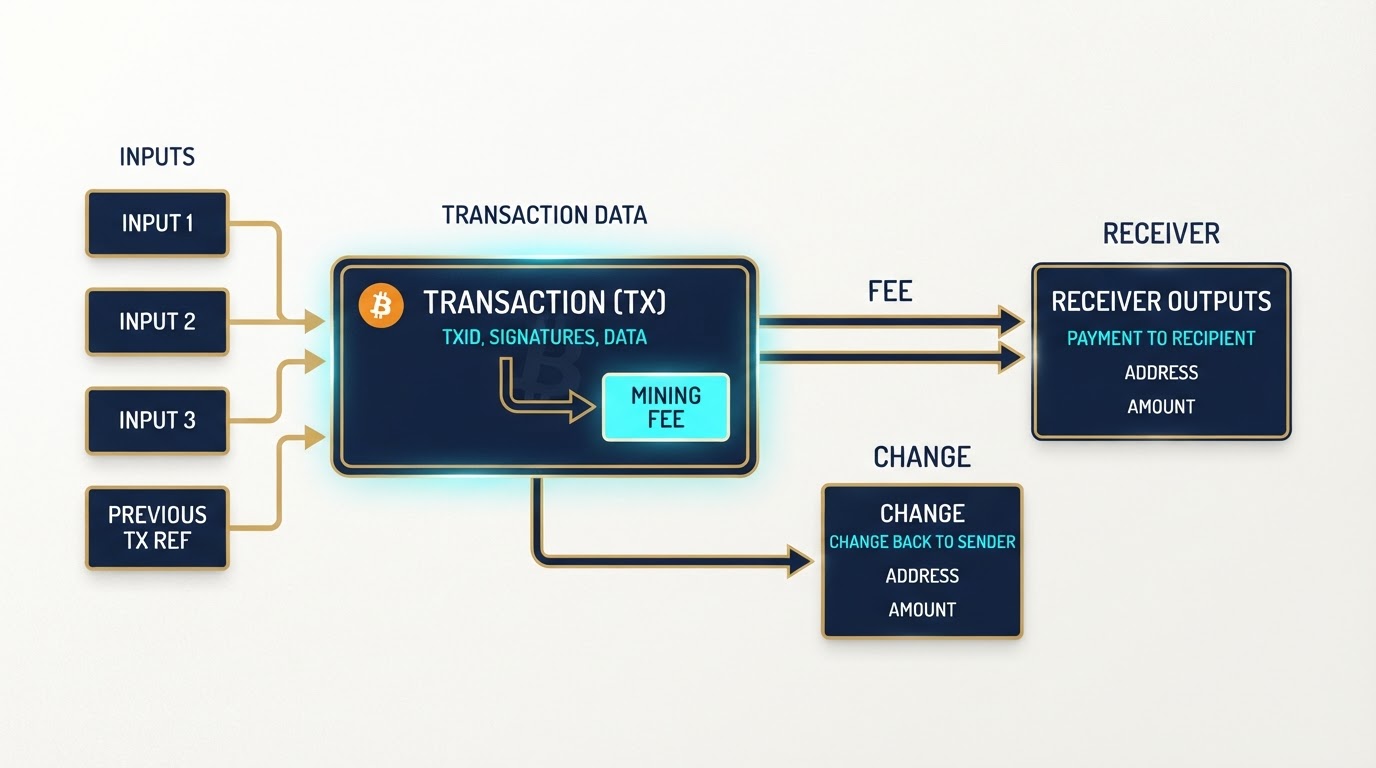
When you send Bitcoin, your transaction selects one or more of your UTXOs as inputs, consumes them, and creates new outputs for the recipient and for any change returned to you. Each input and output adds data to the transaction, and the network fee depends on the transaction's total data size. You can read more in the UTXO dictionary entry.
A Bitcoin transaction consumes inputs and creates outputs plus change, with a fee included.
The Cash-Change Analogy
Think of UTXOs like physical bills and coins in your pocket. If you have one $100 bill and need to pay $30, you hand over the $100 bill and receive $70 in change. If you instead have one hundred $1 bills, you must count out thirty of them—a slower, heavier process. In Bitcoin, "heavier" means more transaction data, which can mean a higher fee.
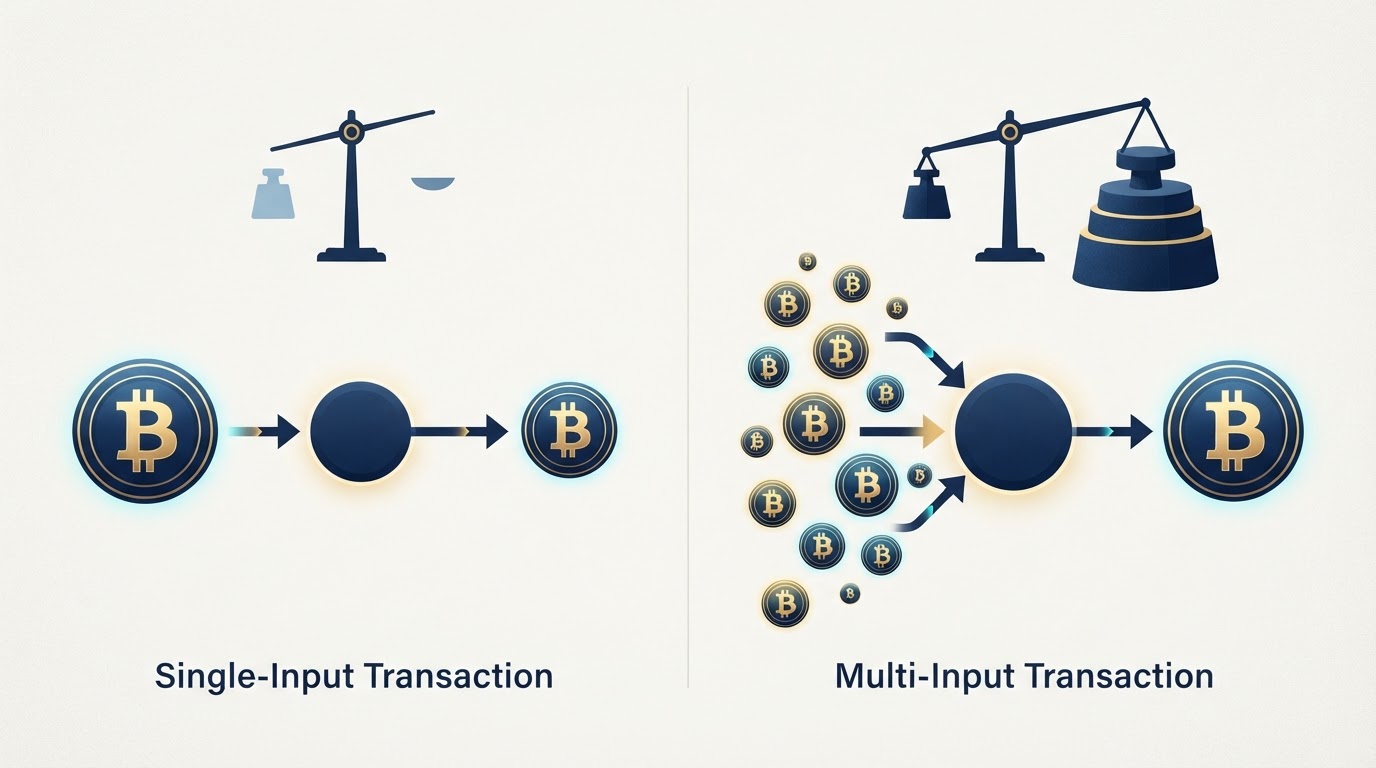
A wallet with one large UTXO can often make a payment with a single input. A wallet with many small UTXOs may need to combine several inputs to gather enough value, producing a larger transaction. The difference in data size can be significant, especially when network fees are high. For a deeper look at what drives fees, see our article on why Bitcoin transaction fees rise.
A transaction spending many small UTXOs is larger in data size than one spending a single large output.
Why Small Outputs Affect Future Fees
Bitcoin network fees are based on transaction data size, measured in virtual bytes, not on the dollar value being sent. Each input your transaction spends adds roughly 70 to 100 virtual bytes (the exact size depends on the script type). A transaction spending one input is much smaller than one spending ten inputs.
If you accumulate many small UTXOs—through frequent small withdrawals or many small payments received—spending them later can require a large transaction. At a high fee rate, that larger transaction costs more. This is why some people who stack sats think about how their withdrawal pattern affects future spending costs. There is no universally correct number of UTXOs; the right approach depends on your activity, fee conditions, and privacy preferences.
Exchange Balances vs. On-Chain UTXOs
An important distinction: when you buy Bitcoin on an exchange, the exchange credits an internal balance to your account. That balance is a record the exchange maintains—it is not an on-chain UTXO under your control. No Bitcoin transaction is created on your behalf until you withdraw to your own wallet.
This means buying repeatedly on an exchange does not, by itself, create many small UTXOs in your wallet. UTXOs are created when Bitcoin moves on-chain—most commonly when you withdraw to a self-custody wallet. Each withdrawal creates at least one output to your address. Frequent small withdrawals can create many small UTXOs; fewer, larger withdrawals create fewer, larger ones. The tradeoff is between custody exposure (leaving Bitcoin on an exchange) and on-chain costs (withdrawing frequently). There is no single threshold that fits everyone.
UTXOs and Privacy
How you select and combine UTXOs also affects privacy. When a transaction spends multiple inputs together, an observer can infer that those outputs belong to the same wallet. Combining outputs from different sources can reveal connections between addresses that you might prefer to keep separate. This is the basis of coin control—a wallet feature that lets you choose which specific outputs a transaction spends, rather than letting the wallet select automatically.
Some wallets offer coin-control features for users who want finer-grained control over input selection. Not every wallet exposes these options. If privacy or fee management matters to you, check whether your wallet supports coin control and read its documentation.
Understand Bitcoin Transaction Fees
UTXO size and count directly affect what you pay to send Bitcoin. Learn how fees are calculated and when they rise.
UTXO stands for "unspent transaction output." It is a discrete, spendable chunk of Bitcoin from a previous transaction. Your wallet balance is the sum of all UTXOs it can spend.
Do small UTXOs cost more to spend?
They can. Spending many small UTXOs requires more inputs, which makes the transaction larger in data size. Since fees are based on data size, a larger transaction can cost more—especially when the fee rate is high.
Does buying on an exchange create UTXOs?
Not in your wallet. An exchange credits an internal balance to your account. On-chain UTXOs under your control are created only when you withdraw Bitcoin to your own wallet.
Should I consolidate all my small UTXOs?
There is no universal answer. Consolidation combines many outputs into fewer ones, which costs a fee now but may reduce future spending costs. It also has privacy implications because it links the combined outputs. Whether it makes sense depends on your situation and current fee conditions.
What is coin control?
Coin control is a wallet feature that lets you choose which specific UTXOs a transaction spends, rather than letting the wallet select automatically. It gives you more control over fees and privacy, but not every wallet offers it.
Key takeaway: UTXOs are discrete spendable outputs, not a running balance. Spending many small outputs creates larger, potentially costlier transactions, and how you combine outputs affects privacy. Buying on an exchange does not create on-chain UTXOs until you withdraw.
UTXO stands for 'unspent transaction output.' It is a discrete, spendable chunk of Bitcoin from a previous transaction. Your wallet balance is the sum of all UTXOs it can spend.
Do small UTXOs cost more to spend?
They can. Spending many small UTXOs requires more inputs, which makes the transaction larger in data size. Since fees are based on data size, a larger transaction can cost more—especially when the fee rate is high.
Does buying on an exchange create UTXOs?
Not in your wallet. An exchange credits an internal balance to your account. On-chain UTXOs under your control are created only when you withdraw Bitcoin to your own wallet.
Should I consolidate all my small UTXOs?
There is no universal answer. Consolidation combines many outputs into fewer ones, which costs a fee now but may reduce future spending costs. It also has privacy implications because it links the combined outputs. Whether it makes sense depends on your situation and current fee conditions.
What is coin control?
Coin control is a wallet feature that lets you choose which specific UTXOs a transaction spends, rather than letting the wallet select automatically. It gives you more control over fees and privacy, but not every wallet offers it.
Enjoyed this story?
Share it with your network and help others discover the history and utility of Bitcoin.
Disclaimer: This content is provided for general educational and informational purposes and is not financial, investment, legal, or tax advice. Bitcoin involves risk, including the possible loss of value. Consider your circumstances and consult qualified professionals when appropriate.