BIP39 Passphrase: How It Differs From a Wallet Password
Bitcoin Ink Editorial Team•October 27, 2026•8 min read
Share:
BIP39 passphrase is optional information used with a compatible mnemonic to derive a different wallet. It is an extra layer you can add to your seed phrase, but it is not the same thing as the seed phrase, a device PIN, or an app password. Understanding what it does—and what it does not do—helps you avoid the backup mistakes that can hide your own funds from you.
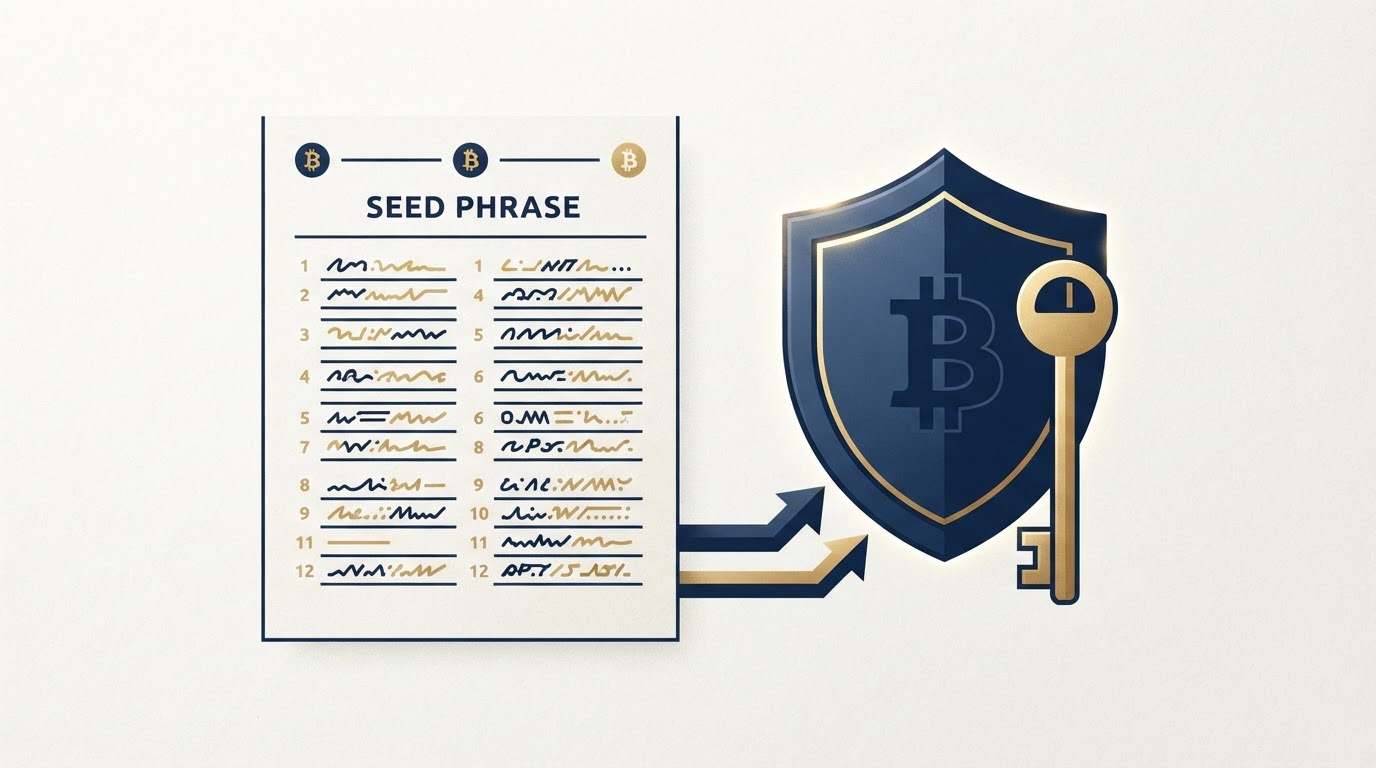
A BIP39 passphrase adds an optional layer on top of your seed phrase, deriving an entirely separate wallet.
Quick Answer
A BIP39 passphrase is an optional string combined with your 12- or 24-word seed phrase to produce a different set of keys and addresses. Every passphrase generates a valid wallet, so a typo does not produce an error—it opens an empty wallet instead. This feature can provide plausible deniability, but it also means losing your passphrase can make your funds permanently inaccessible, even if your seed phrase is safe.
💡 Key Takeaways
A BIP39 passphrase is optional information combined with your seed phrase to derive a different wallet—it is not the same as the seed phrase itself.
Every passphrase produces a valid wallet address, so a single typo opens an empty wallet rather than showing an error message.
A passphrase is not necessarily one word; it can be any string of characters, and not every wallet supports BIP39 passphrases.
A device PIN, an app password, and a BIP39 passphrase serve different purposes and protect different things.
If you use a passphrase, you must back it up alongside your seed phrase—losing either one can make your funds unrecoverable.
Key Takeaways
Optional layer: a passphrase is combined with your seed phrase to derive a different wallet; it is not the seed phrase itself.
Every passphrase works: any passphrase produces a valid wallet address, so a typo opens an empty wallet rather than an error.
Not one word: a passphrase can be any string of characters—letters, numbers, symbols, spaces—not necessarily a single word.
Wallet-specific support: not every wallet supports BIP39 passphrases; check your wallet's documentation before relying on one.
Back it up: if you use a passphrase, you need both the seed phrase and the passphrase to recover your funds.
Table of Contents
What Is a BIP39 Passphrase?
A BIP39 passphrase is an optional addition to the BIP39 mnemonic standard—the same standard that defines your 12- or 24-word seed phrase (BIP39 specification). When you enter a passphrase, the wallet combines it with your seed phrase to derive a completely different set of keys and addresses. Without a passphrase, the wallet derives its default set of addresses. With a passphrase, it derives a separate wallet.
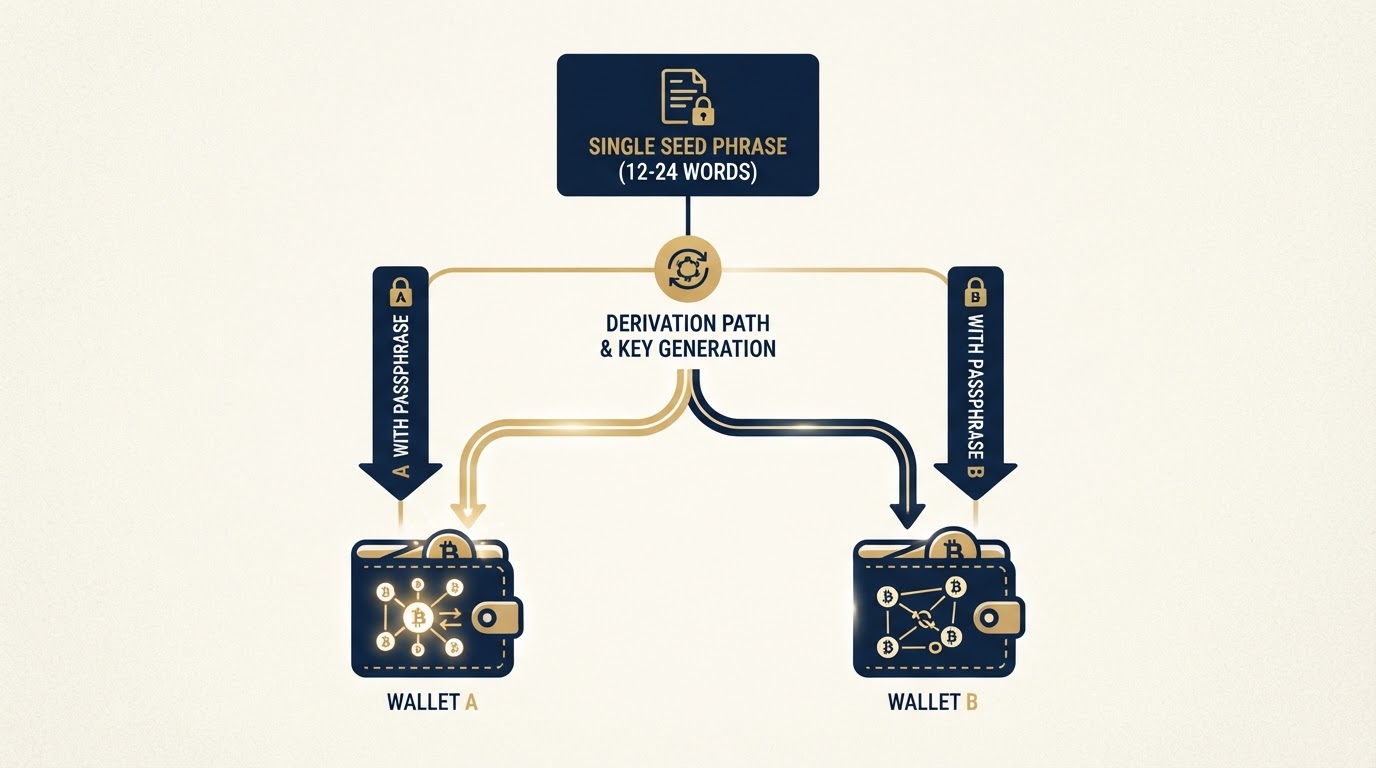
Think of it as a second secret that selects which wallet your seed phrase opens. The same seed phrase with no passphrase produces one wallet; the same seed phrase with passphrase "A" produces a second wallet; with passphrase "B" it produces a third. Each is independent, with its own addresses and balances.
Passphrase vs. Seed Phrase
The seed phrase is the foundation—it encodes the random number from which all keys are derived. The passphrase is an optional modifier that changes which wallet those keys belong to. You need the seed phrase to recover anything; you need the passphrase only if you used one.
If you used a passphrase and lose it, your seed phrase alone will restore the default wallet—with none of the funds you stored under the passphrase. The funds are not gone from the blockchain, but without the exact passphrase, they are inaccessible to you. This is why backing up a passphrase is just as important as backing up the seed phrase itself.
Passphrase vs. PIN vs. Wallet Password
These three terms are often confused, but they protect different things:
Term
What It Protects
What Losing It Means
BIP39 Passphrase
Selects which wallet your seed phrase derives
Funds under that passphrase are inaccessible, even with the seed phrase
Device PIN
Unlocks a hardware wallet's screen
Device can be reset and restored from seed phrase; funds are recoverable
App Password
Unlocks wallet software on your phone or computer
App can be reinstalled and wallet restored from seed phrase
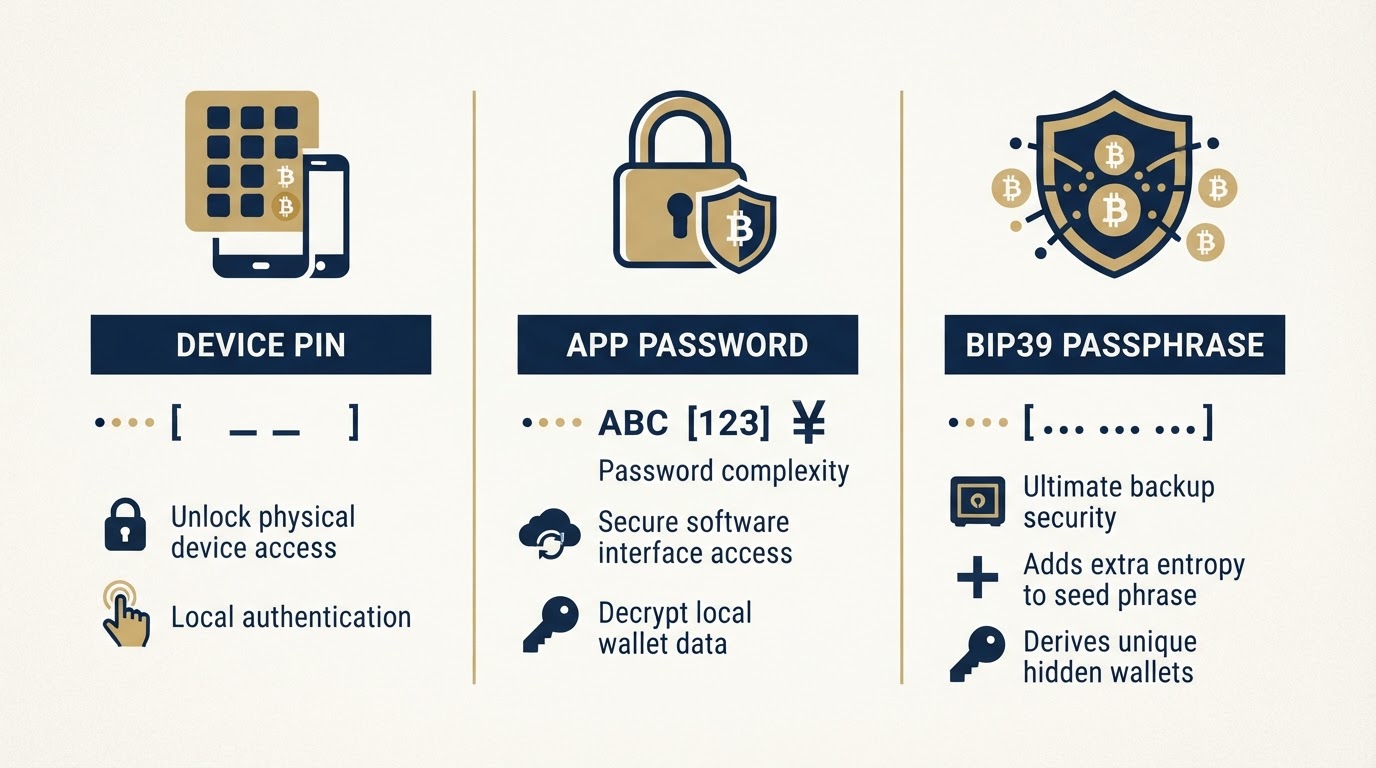
A device PIN, an app password, and a BIP39 passphrase serve different purposes and protect different things.
A device PIN or app password protects access to your wallet software. A BIP39 passphrase protects which wallet your seed phrase opens. Losing a PIN or password is recoverable from your seed phrase; losing a passphrase is not, if you used one.
Why Every Passphrase Produces a Valid Wallet
This is the most important and potentially dangerous feature of BIP39 passphrases: every passphrase produces a valid wallet address. There is no error message for a wrong passphrase. If you type "apple" when you meant "Apple", the wallet happily derives a valid set of addresses—just not the ones holding your funds. The wallet looks empty, but the funds are sitting under the correct passphrase on the blockchain.
This design enables plausible deniability: you can store a small balance under no passphrase (or a decoy passphrase) and your main holdings under a different passphrase. If someone forces you to open your wallet, the default wallet shows only the small balance. But the trade-off is real: if you forget the passphrase, you face the same empty wallet.
The same seed phrase with passphrase A and passphrase B produces two entirely different wallets, each with its own addresses and balances.
The Typo Risk
Because every passphrase is valid, a single typo does not warn you—it silently opens the wrong wallet. This is the most common way people lose access to passphrase-protected funds. If you restore your wallet and see a zero balance, do not panic and do not discard your seed phrase. The funds may be under a slightly different passphrase. Try variations carefully: capitalization, trailing spaces, alternate spellings.
To reduce this risk, some wallet users write down their passphrase exactly as entered, including capitalization and spacing, and store it separately from the seed phrase. Never store the two together—if someone finds both, they have full access to your passphrase-protected wallet.
Not Necessarily One Word
Despite the nickname "25th word," a BIP39 passphrase is not limited to a single word. It can be any string of characters: a phrase, a sentence, a random string of letters and numbers, or even something with spaces and symbols. The wallet treats it as raw input, not as a word from the BIP39 word list. This means you have full flexibility, but also full responsibility for entering it exactly the same way each time.
Wallet-Specific Support
Not every Bitcoin wallet supports BIP39 passphrases. Some wallets do not offer the option at all; others support it but with different defaults or workflows. Before relying on a passphrase, check your wallet's official documentation to confirm it supports BIP39 passphrases and understand how to enable and use them correctly. If you switch wallets, confirm the new wallet supports passphrases and uses the same derivation behavior.
Backup Requirements
If you use a BIP39 passphrase, your backup must include both the seed phrase and the passphrase. Either one alone is not enough to recover your funds. Recommended practices:
Record the passphrase separately from the seed phrase, in a secure physical location.
Write it exactly as entered, including capitalization, spacing, and any special characters.
Test the recovery before relying on it: confirm you can restore the wallet with both pieces of information before sending significant funds.
Never type it online or share it with anyone, just as you would never share your seed phrase.
For detailed guidance on storing recovery information safely, see our guide to how to store a seed phrase. To understand the relationship between your seed phrase and the keys it derives, see our article on seed phrase vs. private key.
Secure Your Wallet Backup
Understanding how your seed phrase, passphrase, and wallet recovery work together is essential to safe self-custody.
No. A seed phrase is the 12- or 24-word mnemonic that encodes the root of your wallet. A BIP39 passphrase is optional information combined with that seed phrase to derive a different wallet. You need the seed phrase to recover anything; the passphrase selects which wallet it opens.
What happens if I type the wrong passphrase?
The wallet derives a valid but empty wallet. There is no error message. Your funds are still on the blockchain under the correct passphrase, but you need to enter the exact same passphrase to access them. Try variations carefully if you suspect a typo.
Does every wallet support BIP39 passphrases?
No. Some wallets do not support passphrases at all, and others implement them differently. Check your wallet's official documentation before relying on one. If you switch wallets, confirm the new one supports passphrases and uses compatible derivation.
Is a passphrase always one word?
No. Despite the nickname "25th word," a BIP39 passphrase can be any string of characters—letters, numbers, symbols, spaces. It is not limited to a single word from the BIP39 word list.
Do I need to back up the passphrase separately?
Yes. If you use a passphrase, you need both the seed phrase and the passphrase to recover your funds. Store them separately so that finding one does not give access to the other. Write the passphrase exactly as entered, including capitalization and spacing.
What is plausible deniability?
Because every passphrase produces a valid wallet, you can store a small balance under no passphrase (or a decoy) and your main holdings under a different passphrase. If forced to open your wallet, only the small balance is visible. The trade-off is that forgetting the passphrase locks you out too.
Key takeaway: A BIP39 passphrase is an optional layer that combines with your seed phrase to derive a different wallet. Every passphrase is valid, so a typo opens an empty wallet rather than an error. Back up both the seed phrase and the passphrase separately, and confirm your wallet supports BIP39 passphrases before relying on one.
No. A seed phrase is the 12- or 24-word mnemonic that encodes the root of your wallet. A BIP39 passphrase is optional information combined with that seed phrase to derive a different wallet. You need the seed phrase to recover anything; the passphrase selects which wallet it opens.
What happens if I type the wrong passphrase?
The wallet derives a valid but empty wallet. There is no error message. Your funds are still on the blockchain under the correct passphrase, but you need to enter the exact same passphrase to access them. Try variations carefully if you suspect a typo.
Does every wallet support BIP39 passphrases?
No. Some wallets do not support passphrases at all, and others implement them differently. Check your wallet's official documentation before relying on one. If you switch wallets, confirm the new one supports passphrases and uses compatible derivation.
Is a passphrase always one word?
No. Despite the nickname '25th word,' a BIP39 passphrase can be any string of characters—letters, numbers, symbols, spaces. It is not limited to a single word from the BIP39 word list.
Do I need to back up the passphrase separately?
Yes. If you use a passphrase, you need both the seed phrase and the passphrase to recover your funds. Store them separately so that finding one does not give access to the other. Write the passphrase exactly as entered, including capitalization and spacing.
What is plausible deniability?
Because every passphrase produces a valid wallet, you can store a small balance under no passphrase (or a decoy) and your main holdings under a different passphrase. If forced to open your wallet, only the small balance is visible. The trade-off is that forgetting the passphrase locks you out too.
Enjoyed this story?
Share it with your network and help others discover the history and utility of Bitcoin.
Disclaimer: This content is provided for general educational and informational purposes and is not financial, investment, legal, or tax advice. Bitcoin involves risk, including the possible loss of value. Consider your circumstances and consult qualified professionals when appropriate.