Bitcoin Ink Editorial Team•October 27, 2026•8 min read
Share:
How to calculate Bitcoin profit starts with subtracting your total purchase cost from your sale proceeds after the fees you enter. The math is straightforward once you separate the pieces: what you paid to acquire the Bitcoin, what you received when you sold it, and the fees involved at each step.
Bitcoin profit is the difference between what you receive after selling and what you spent to buy, with fees accounted for at each step.
Quick Answer
To calculate Bitcoin profit, subtract your total purchase cost (the Bitcoin you bought plus any purchase fees) from your net sale proceeds (the dollars you receive after selling fees). If the result is positive, you have a gain. If it is negative, you have a loss. ROI divides that profit or loss by your total purchase cost to express it as a percentage. Taxes and costs you did not enter are excluded.
💡 Key Takeaways
Bitcoin profit is your net sale proceeds after entered fees minus your total purchase cost including fees—not simply the difference between the buy and sell price.
ROI (return on investment) measures profit relative to your total purchase cost, expressing the gain or loss as a percentage.
Selling below your purchase cost produces a capital loss, not a profit; the same formula applies whether the result is positive or negative.
Taxes and costs you did not enter are excluded from the calculation; actual after-tax returns may differ.
An unsold position shows an unrealized gain or loss—an estimate that changes with the market price until you sell.
What Profit Means
Profit in the context of Bitcoin is the difference between what you spent to acquire your Bitcoin and what you received when you sold it, after accounting for the fees you entered at each step. It is not simply the difference between the buy price and sell price per Bitcoin—although that per-Bitcoin difference is part of the calculation, the total also depends on how much Bitcoin you bought and sold.
Three numbers matter:
Total purchase cost: the dollar amount you paid for the Bitcoin plus any purchase fees.
Net sale proceeds: the dollar amount you received when selling, minus any selling fees.
Profit or loss: net sale proceeds minus total purchase cost.
If you bought 0.1 BTC, your total purchase cost depends on both the per-BTC price and the quantity. If you bought 1 BTC, the same per-BTC price produces a cost ten times larger. The quantity matters as much as the price.
The Formula
The core calculation is:
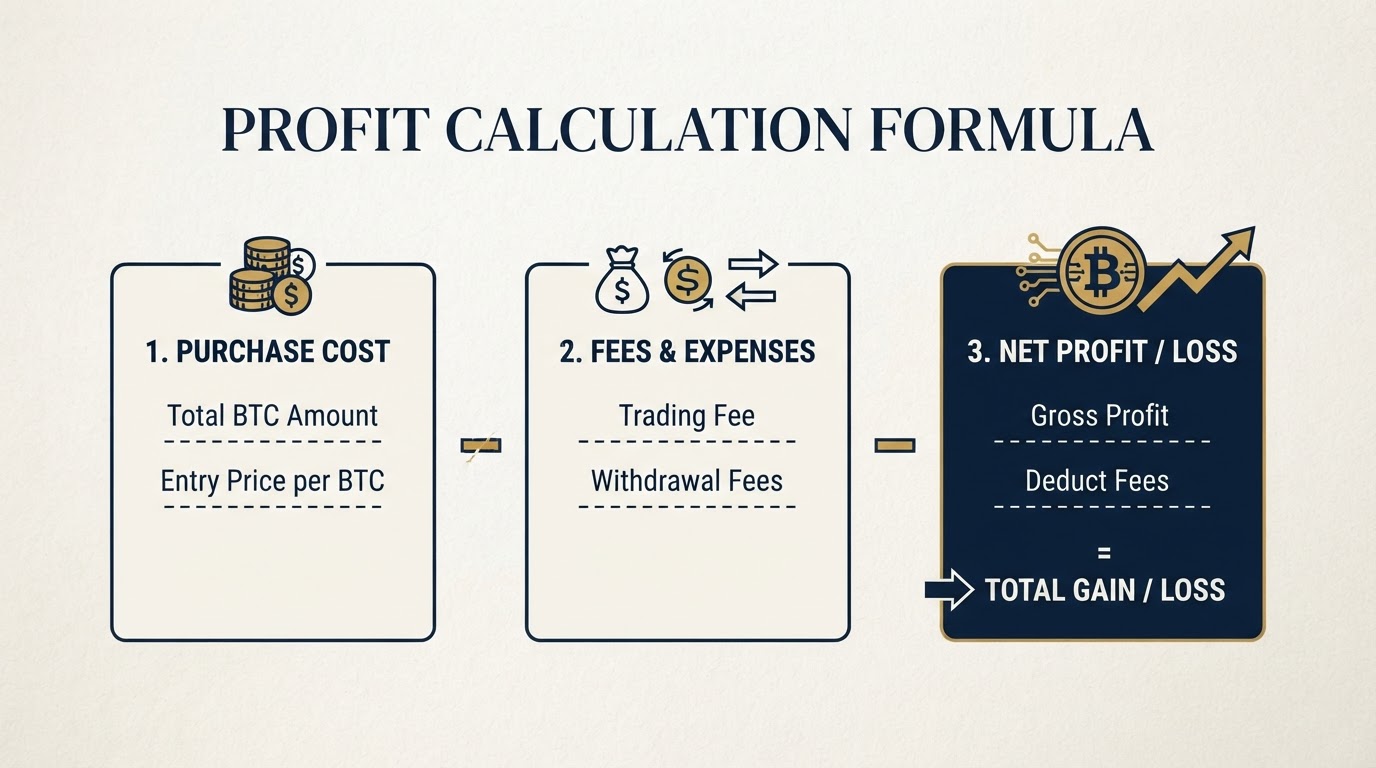
Profit = Net sale proceeds − Total purchase cost
Where:
Net sale proceeds = (BTC sold × sale price per BTC) − selling fees
Total purchase cost = (BTC bought × purchase price per BTC) + purchase fees
The formula subtracts purchase cost and entered fees from gross sale proceeds to arrive at net profit.
If the result is positive, you have a gain. If it is negative, you have a loss. The formula works the same way in either direction.
A Worked Example with Fees
Suppose you buy 0.1 BTC at $50,000 per BTC and pay a $50 purchase fee. Your total purchase cost is:
0.1 × $50,000 + $50 = $5,000 + $50 = $5,050
Later, you sell 0.1 BTC at $60,000 per BTC and pay a $60 selling fee. Your gross sale proceeds are $6,000, and your net sale proceeds are:
0.1 × $60,000 − $60 = $6,000 − $60 = $5,940
Your profit is:
$5,940 − $5,050 = $890
Note: This is an illustrative example with hypothetical prices and fees, not a live quote or investment recommendation.
Calculating ROI
ROI (return on investment) expresses your profit as a percentage of your total purchase cost:
ROI = (Profit ÷ Total purchase cost) × 100
Using the worked example:
ROI = ($890 ÷ $5,050) × 100 ≈ 17.62%
ROI tells you how much you gained relative to what you put in. A higher ROI means a larger return on the same investment. It does not account for the time you held the Bitcoin—annualized return (CAGR) does that, but only for a valid holding period.
A Gain vs. a Loss Scenario
The same formula applies whether the result is a gain or a loss. If you had sold the same 0.1 BTC at $40,000 per BTC instead of $60,000, the calculation would be:
Net sale proceeds = 0.1 × $40,000 − $60 = $4,000 − $60 = $3,940
Profit = $3,940 − $5,050 = −$1,110 (a loss)
ROI = (−$1,110 ÷ $5,050) × 100 ≈ −21.98%
The same formula produces a gain when sale proceeds exceed purchase cost and a loss when they do not.
A negative result is a capital loss, not a profit. The formula does not change—only the sign of the result does.
What "After Fees" Actually Means
"After fees" in this calculation means after the fees you entered. It does not mean after every possible cost. The calculation excludes:
Taxes on any gains, which depend on your jurisdiction and individual circumstances.
Costs you did not enter, such as spread, deposit fees, or withdrawal fees not included in the calculation.
Opportunity cost—what you could have earned by investing elsewhere.
Your actual after-tax return may be lower than the calculated profit. Always keep records of your purchase and sale transactions for tax reporting, and consult a qualified tax professional for advice specific to your situation. See our guide to Bitcoin purchase fees for a fuller breakdown of the costs involved.
Unrealized Gains and Losses
If you have not sold your Bitcoin yet, any gain or loss is unrealized. The market value of your holdings changes with the price, but you have not locked in a profit or loss until you sell. An unrealized gain is an estimate based on the current market price; it can disappear if the price falls before you sell.
To estimate an unrealized gain or loss, use the current market price as your hypothetical sale price in the same formula. Just remember: the result is an estimate, not a realized return. For exploring hypothetical future price scenarios, see our Bitcoin future value calculator.
Calculate Your Own Bitcoin Profit
Enter your purchase price, sale price, BTC quantity, and fees to see your exact profit, loss, and ROI with our interactive calculator.
Key takeaway: Bitcoin profit is net sale proceeds minus total purchase cost, with the fees you entered accounted for on both sides. ROI expresses that as a percentage of what you invested. The same formula handles gains and losses—taxes and unentered costs are excluded.
Is profit just the difference between the buy and sell price?
No. The difference between the buy and sell price is per Bitcoin. Your total profit also depends on how much Bitcoin you bought and sold, plus the fees at each step. Profit equals net sale proceeds minus total purchase cost.
What does "after fees" include?
It includes the fees you entered in the calculation—typically purchase fees and selling fees. It excludes taxes and any costs you did not enter. Your actual after-tax return may be lower.
How is ROI calculated?
ROI is your profit divided by your total purchase cost, multiplied by 100 to express it as a percentage. It measures how much you gained relative to what you invested.
What if I sell below my purchase price?
The same formula applies. If your net sale proceeds are below your total purchase cost, the result is a negative number—a capital loss. The formula does not change; only the sign of the result does.
Does this calculation include taxes?
No. The calculation excludes taxes. Capital gains tax depends on your jurisdiction, holding period, and individual circumstances. Consult a qualified tax professional for advice specific to your situation.
What is an unrealized gain?
An unrealized gain is an estimated increase in value based on the current market price of Bitcoin you still hold. It is not locked in until you sell, and it can change as the market price moves.
Enjoyed this story?
Share it with your network and help others discover the history and utility of Bitcoin.
Disclaimer: This content is provided for general educational and informational purposes and is not financial, investment, legal, or tax advice. Bitcoin involves risk, including the possible loss of value. Consider your circumstances and consult qualified professionals when appropriate.