

Stacking sats means gradually accumulating small amounts of Bitcoin, measured in satoshis, through purchases or payments you receive. Because one Bitcoin can be divided into 100 million smaller units, you do not need to buy an entire coin to own Bitcoin.
Sats are units of Bitcoin, not a separate token or another cryptocurrency. One BTC equals 100,000,000 sats. Stacking sats increases the total quantity of Bitcoin you hold, but it does not guarantee growth in dollar value: if the market price of Bitcoin declines, your dollar value can fall even as your sat count rises.
Table of Contents
What Does Stacking Sats Mean?
The phrase stacking sats is community slang for saving or acquiring Bitcoin in small, manageable fractions. Instead of saving thousands of dollars to buy a full Bitcoin, someone stacking sats might convert $10, $25, or $50 into Bitcoin whenever their personal budget permits, or receive small payments directly in satoshis (Ledger Academy glossary).
It is important to distinguish stacking sats from staking tokens in proof-of-stake cryptocurrencies. Stacking is not staking: simply holding Bitcoin does not generate automatic yield, interest, or dividends. Bitcoin uses proof-of-work consensus, and the Bitcoin network does not pay holders a yield just for keeping coins in a wallet. Your satoshi balance only increases when you deposit, purchase, or receive additional Bitcoin.
How Many Sats Are in One Bitcoin?
A satoshi—often shortened to sat—is the smallest accounting unit of Bitcoin currently recorded on the blockchain ledger. It is named after Bitcoin's pseudonymous creator, Satoshi Nakamoto:
- 1 BTC = 100,000,000 satoshis
- 1 sat = 0.00000001 BTC
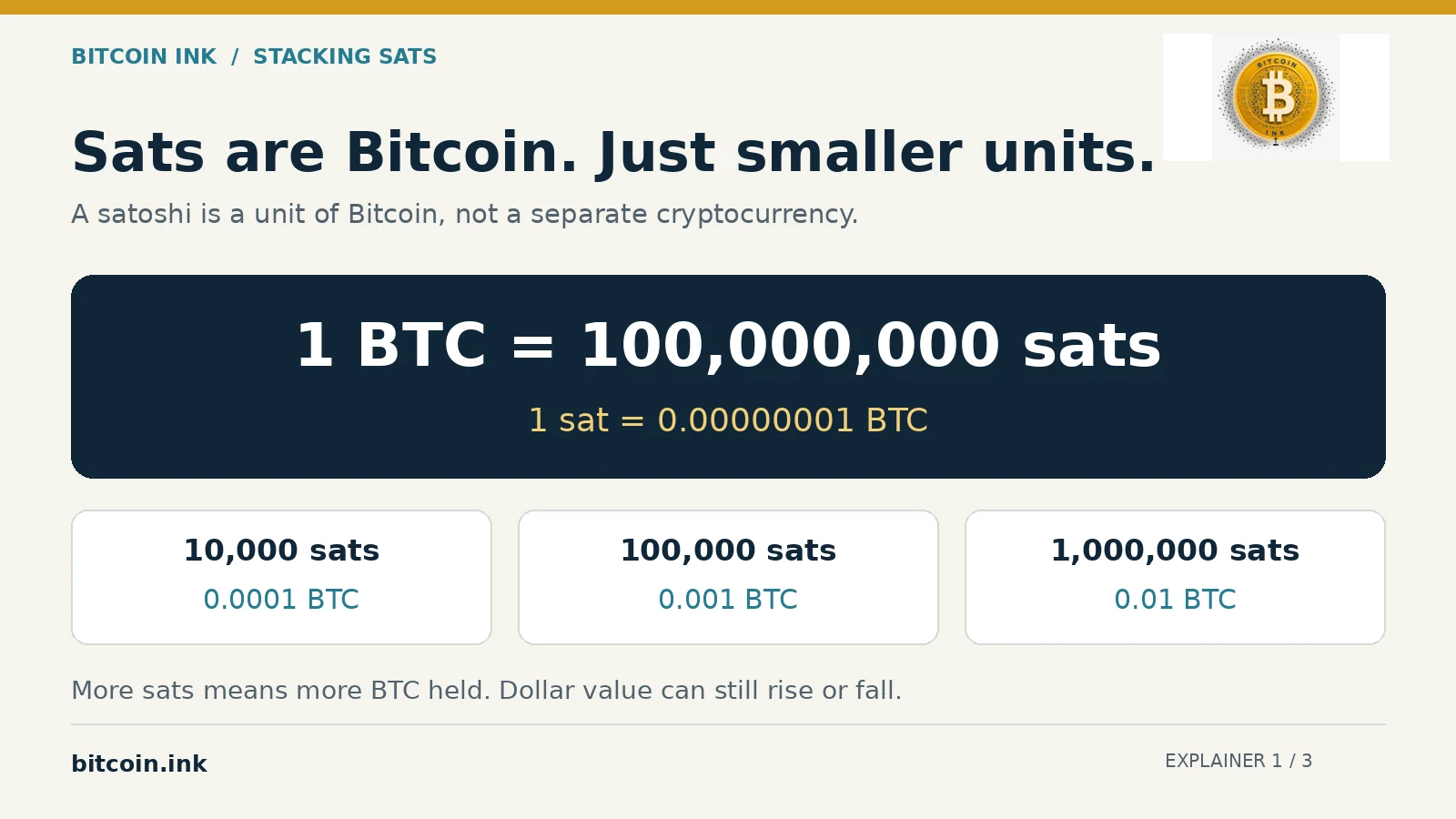
Because Bitcoin is divisible to eight decimal places, buyers never need to wait until they can afford a full coin. To learn more about how units work, see our beginner explanation of what a satoshi is or review whether you can buy less than one Bitcoin.
Stacking Sats vs. Dollar-Cost Averaging
While the terms are often used interchangeably in casual conversation, stacking sats and dollar-cost averaging (DCA) describe slightly different approaches:
| Feature | Stacking Sats | Dollar-Cost Averaging (DCA) |
|---|---|---|
| Core concept | Accumulating small amounts of Bitcoin, whether planned or opportunistic | Investing a fixed dollar amount at strict, regular time intervals (Investor.gov glossary) |
| Schedule | Flexible: daily, weekly, round-ups, cash-back, or whenever extra savings allow | Systematic: e.g., exactly $25 every Monday morning regardless of price |
| Sources | Purchases, freelance income, Lightning micro-tips, rewards | Cash purchases from fiat currency deposits |
| Risk profile | Subject to market volatility; holdings may drop in dollar terms | Smooths the average entry price, but does not guarantee a profit or eliminate loss |
When you invest the same dollar amount regularly, that fixed amount buys more sats when the price is lower and fewer sats when the price is higher. This mathematical effect lowers your average purchase price compared to buying at market peaks, but dollar-cost averaging does not eliminate market risk. If Bitcoin's price enters a prolonged decline, the total value of your accumulated sats will still fall.
What Do Small Bitcoin Purchases Buy?
How many sats does a $10, $25, or $50 purchase actually yield? The formula is straightforward:
Sats acquired = (Amount actually converted to BTC ÷ BTC price) × 100,000,000
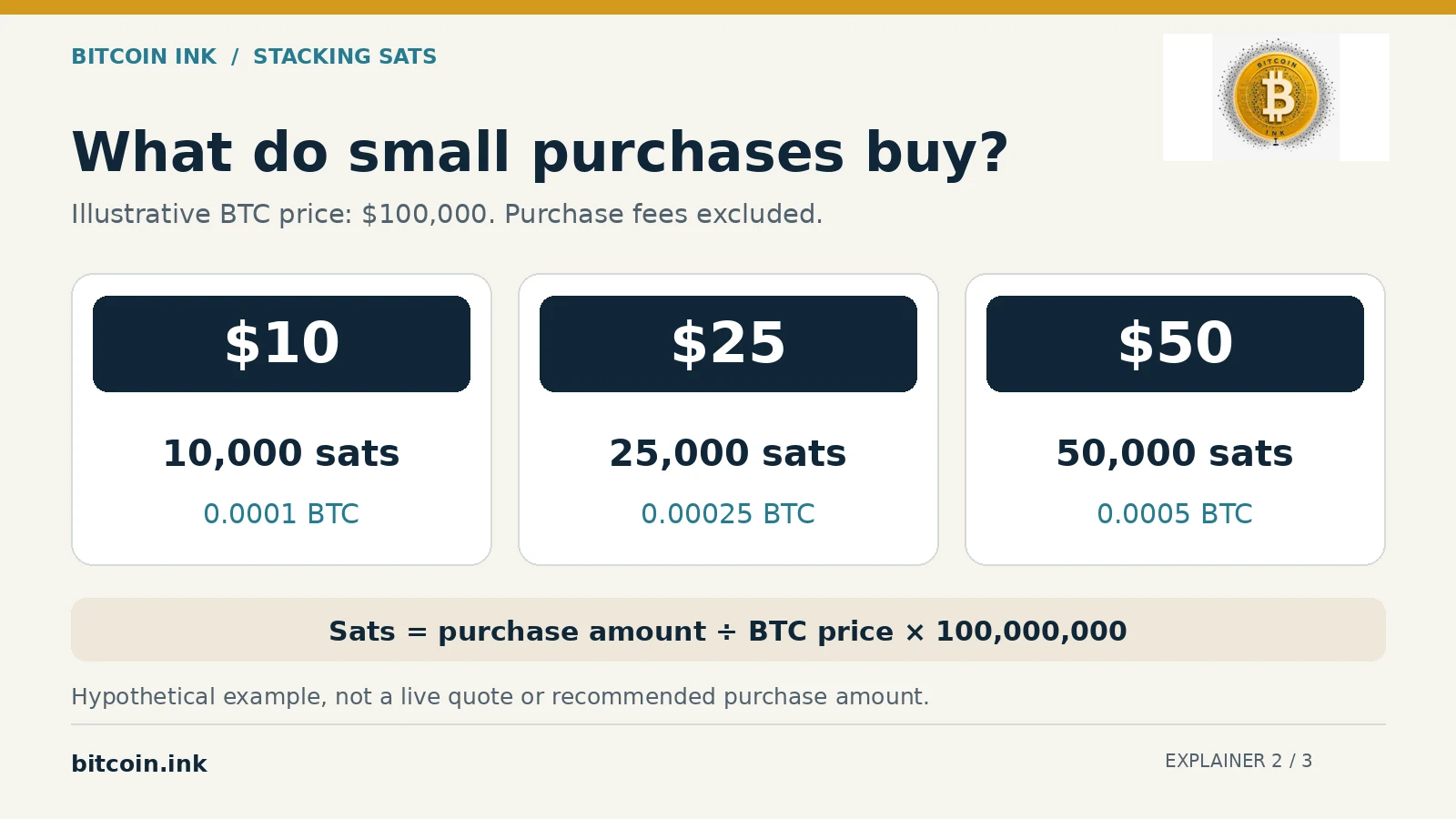
Below is a breakdown of what common purchase amounts yield at an illustrative Bitcoin price of $100,000, assuming no fees are deducted:
| Purchase Amount (USD) | Bitcoin Amount (BTC) | Satoshis Acquired (sats) |
|---|---|---|
| $10.00 | 0.0001 BTC | 10,000 sats |
| $25.00 | 0.00025 BTC | 25,000 sats |
| $50.00 | 0.0005 BTC | 50,000 sats |
| $100.00 | 0.001 BTC | 100,000 sats |
Note: This table is an illustrative calculation based on a round $100,000 price for clear math. It is not a live fee quote, price prediction, or purchase recommendation. Live Bitcoin prices change continuously.
Check Any Dollar Amount in Sats
Want to see how many satoshis your specific budget buys at current market rates? Use our interactive tool to calculate live sats and BTC values.
Convert your amount into satsHow Fees Affect Stacking Sats
When you make frequent, small Bitcoin purchases, fees can consume a surprisingly large percentage of your budget if you do not pay close attention. It is helpful to distinguish between the four main types of costs (see our guide to Bitcoin purchase fees):
- Trading fees: The commission an exchange charges to execute a buy order (often 0.1% to 1.5% for standard orders, or a flat minimum like $0.99 for small card purchases).
- The spread: The hidden markup between the market buy price and sell price. Simple "one-click" purchase apps often bundle their fee into a wider spread.
- Exchange withdrawal charges: A flat or dynamic fee charged by an exchange when you move Bitcoin off the platform to your personal wallet.
- Bitcoin network fees: The fee paid directly to Bitcoin miners to confirm an on-chain transaction into a block.
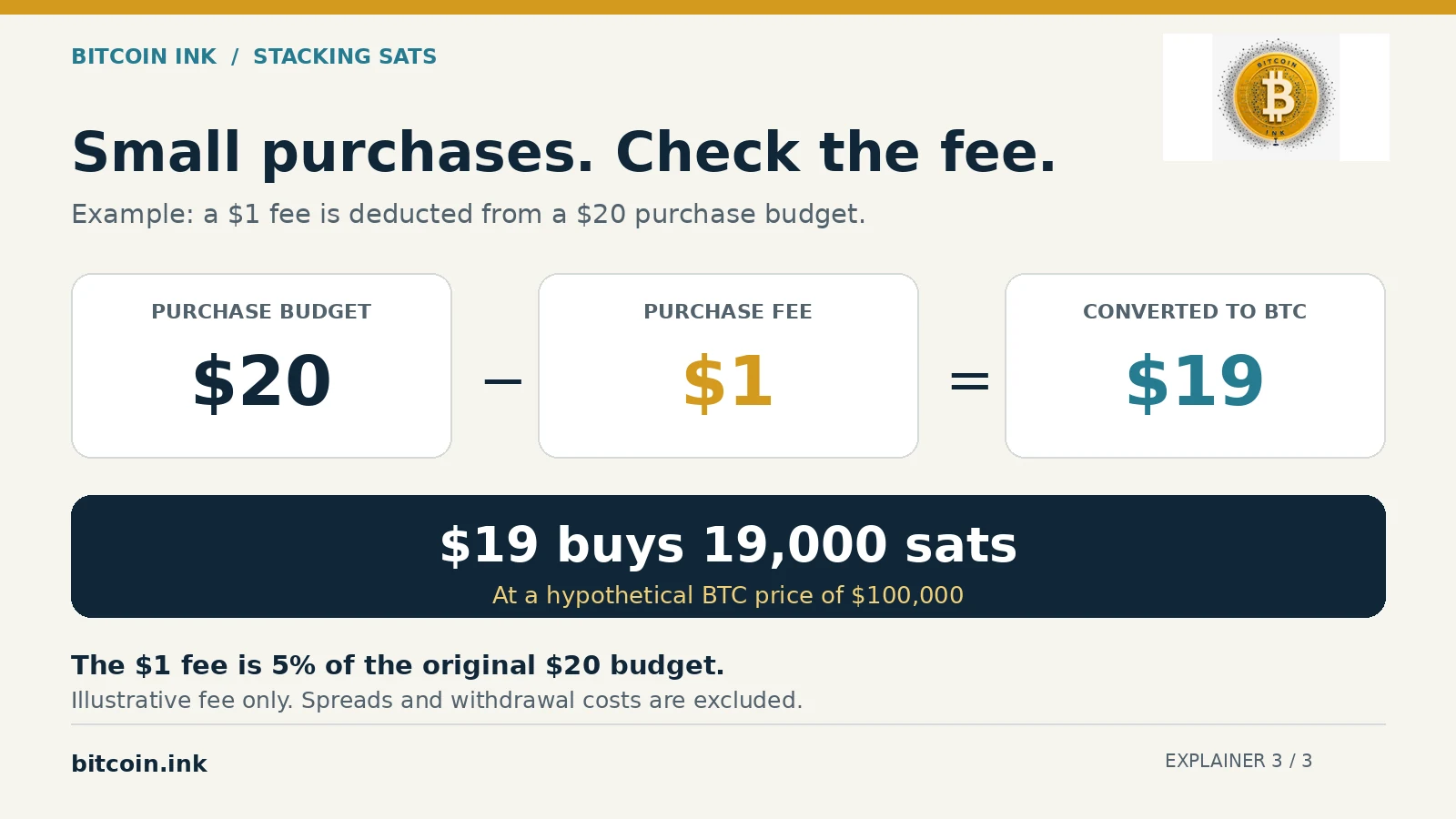
Consider the fee example shown above:
- Suppose you allocate a $20 purchase budget on a platform with a flat $1 minimum purchase fee.
- The $1 fee is deducted first, leaving $19 actually converted to Bitcoin.
- At a hypothetical Bitcoin price of $100,000, your $19 buys 19,000 sats instead of the 20,000 sats you would get with zero fees.
- The $1 fee equals 5% of your total budget.
If you were instead investing $200 on the same platform with a $1 fee, the fee would represent just 0.5% of your capital. For people stacking sats with small amounts, choosing a platform with low percentage fees rather than high fixed minimums is essential.
Buying Bitcoin and Withdrawing It Are Different Steps
A common point of confusion for beginners is the difference between buying Bitcoin and moving it to personal custody.
When you buy $10 or $25 of Bitcoin on an exchange, the platform simply updates an internal database entry crediting your account. No on-chain Bitcoin transaction occurs at the moment of purchase. Your Bitcoin remains in the custody of the exchange.
Withdrawing that Bitcoin to your own self-custody hardware wallet is a separate step (how to move Bitcoin from an exchange to a wallet; Bitcoin.org security best practices). Making frequent, small on-chain withdrawals introduces two practical challenges:
- Exchange withdrawal fees: Many exchanges charge a flat withdrawal fee (such as 0.0001 to 0.0005 BTC). If you withdraw a tiny $15 purchase, a fixed withdrawal fee could consume a substantial portion of the amount.
- UTXO buildup: On the Bitcoin blockchain, each withdrawal creates an unspent transaction output (UTXO) in your wallet (Bitcoin Developer Documentation on transactions). If you make fifty $10 withdrawals over a year, your wallet will hold 50 tiny UTXOs. When you later want to spend or send that Bitcoin, your wallet must combine dozens of inputs into a single transaction, requiring far more virtual bytes of block space and resulting in a significantly higher miner fee.
This creates an important trade-off: leaving funds on an exchange exposes you to counterparty risk ("not your keys, not your coins"), while withdrawing tiny amounts every day generates excessive fees and UTXO fragmentation. Many experienced users strike a balance by accumulating a meaningful batch on the exchange before initiating a single consolidated withdrawal to cold storage. There is no universal dollar threshold that fits every person; the right balance depends on your budget, exchange withdrawal fees, and prevailing network fee conditions.
A Practical Stacking Sats Checklist
Before beginning a recurring sat-stacking routine, review this practical checklist to keep your costs and security in order:
- ✓ Understand all purchase costs: Check the trading fee, deposit charge, and price spread before placing small recurring orders.
- ✓ Review recurring schedules: If you set up an automated daily or weekly buy, confirm your bank or card does not charge recurring transfer fees.
- ✓ Protect the account: Enable strong two-factor authentication (2FA) using an authenticator app or hardware key, never plain SMS.
- ✓ Know who controls the keys: Understand whether your sats are stored on a custodial exchange or in a private, non-custodial wallet you control.
- ✓ Keep purchase records: Track the date, dollar cost, and number of sats acquired for future tax reporting and cost-basis accounting.
- ✓ Plan withdrawals thoughtfully: Balance counterparty risk against withdrawal fees and UTXO management before withdrawing every small buy.
- ✓ Remember market volatility: More sats means more Bitcoin quantity, but it does not protect against a decline in market value. Use our Bitcoin profit calculator to model how price movements and fees affect net returns.
Common mistakes to avoid:
- Confusing sats with an altcoin: Satoshis are simply fractions of Bitcoin. They are not a new token or an ICO.
- Overlooking minimum fees: Paying a $1.50 fee on a $10 purchase is a 15% immediate loss of purchasing power.
- Mistaking balance growth for profit: Having more satoshis than last month does not automatically mean your investment is in profit in dollar terms if the price has dropped.
Frequently Asked Questions
What does stacking sats mean?
Stacking sats means accumulating small amounts of Bitcoin over time through purchases or payments received. It reflects the idea that anyone can save in Bitcoin without needing to buy a whole coin.
How many sats are in one Bitcoin?
There are exactly 100,000,000 (one hundred million) satoshis in one Bitcoin. Each satoshi equals 0.00000001 BTC.
Is stacking sats the same as dollar-cost averaging?
They are related, but not identical. Stacking sats is a broader mindset of accumulating small fractions of Bitcoin whenever possible. Dollar-cost averaging (DCA) is a disciplined investment strategy of investing a fixed dollar amount at fixed calendar intervals.
Can I buy sats without buying a whole Bitcoin?
Yes. Most regulated exchanges and Bitcoin brokerages allow purchases starting at $5 or $10. You receive the fractional amount of Bitcoin corresponding to your purchase budget minus fees.
Does stacking sats earn interest?
No. Simply holding Bitcoin in a private wallet does not generate interest, dividends, or yield. Stacking sats increases your balance only through additional deposits or buys.
Can I lose money while stacking sats?
Yes. Bitcoin is a volatile asset. Even though the quantity of sats you hold will never decrease unless you spend or lose them, their market value in US dollars can fall significantly.
How much are 100,000 sats worth?
100,000 sats equals 0.001 BTC. Its dollar value depends on the current market price of Bitcoin: at a $60,000 BTC price, 100,000 sats is worth $60; at $100,000 BTC, it is worth $100. Use our satoshi to USD converter to check live values.
Key takeaway: Stacking sats is an accessible way to build a Bitcoin holding within any personal budget, but success depends on managing purchase fees, planning custody withdrawals, and understanding market volatility.


