Replace by Fee: How Bitcoin Transaction Fee Bumping Works
Bitcoin Ink Editorial Team•November 2, 2026•7 min read
Share:
Replace by fee lets a supported Bitcoin wallet replace an unconfirmed transaction with one offering a higher fee. When the network is busy and your transaction is stuck because its fee was too low, fee bumping can encourage miners to confirm the replacement instead of the original. Understanding when RBF is available—and when it is not—helps you avoid waiting indefinitely for a transaction that may never confirm.
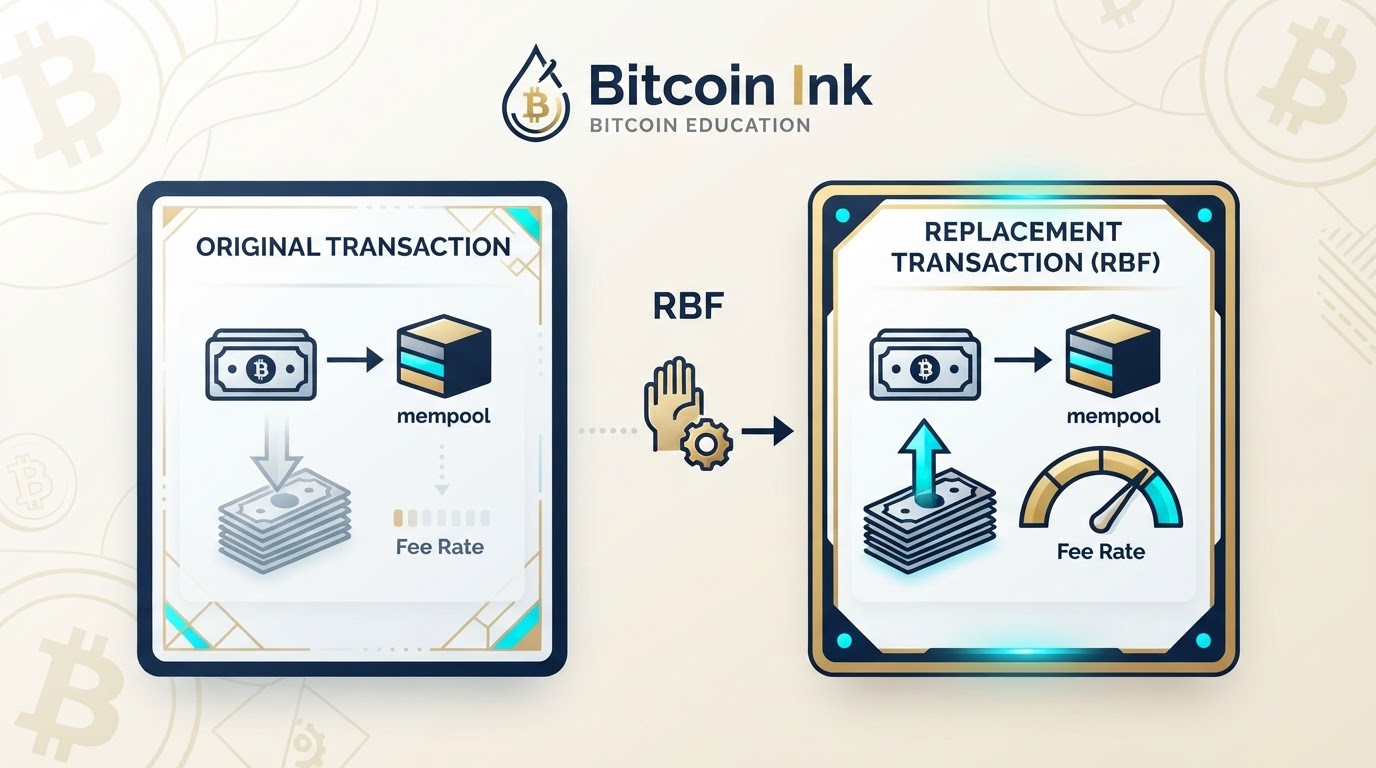
Replace by fee replaces an unconfirmed transaction with a higher-fee version.
Quick Answer
Replace by fee (RBF) is a Bitcoin feature defined in BIP125 that allows a sender to replace an unconfirmed transaction with a new one that pays a higher fee. The replacement must spend the same inputs and offer a sufficiently higher fee rate to be accepted by nodes that support RBF. Not all transactions are replaceable, and not all wallets expose the option. RBF does not guarantee confirmation—it only makes the replacement more economically attractive to miners.
💡 Key Takeaways
Replace by fee (RBF) lets a supported wallet replace an unconfirmed transaction with one offering a higher fee.
Not every transaction or wallet supports user-facing fee replacement—check your wallet's documentation.
RBF does not guarantee confirmation by a specific time; it only makes the replacement more attractive to miners.
Newer relay policies can affect how replacements propagate; support varies across wallets and services.
If your wallet does not support RBF, child-pays-for-parent (CPFP) may be an alternative in some situations.
Key Takeaways
RBF replaces, it does not duplicate: the original unconfirmed transaction is replaced, not sent alongside the new one.
Opt-in by default: a transaction must be marked as replaceable when created; not every wallet enables this by default.
No timing guarantee: a higher fee improves the odds of confirmation but does not promise a specific confirmation time.
Wallet support varies: check your wallet's documentation to confirm it supports user-facing RBF.
CPFP is an alternative: if RBF is unavailable, child-pays-for-parent may work in some situations.
Table of Contents
How Replace by Fee Works
When you send a Bitcoin transaction, it enters the mempool—the waiting area for unconfirmed transactions. Miners select transactions from the mempool and include them in blocks, generally preferring those with higher fee rates. If your transaction's fee rate is too low relative to current demand, it may sit unconfirmed for a long time.
If the original transaction was marked as replaceable (signaled via BIP125), you can create a replacement transaction that spends the same inputs but pays a higher fee. Nodes that support RBF will accept the replacement and drop the original from their mempools. The replacement must meet certain conditions: it must spend at least one of the same inputs, pay a sufficiently higher fee, and not introduce new conflicts that violate the policy. See the BIP125 specification for the full rules.
The replacement transaction pays a higher fee rate, making it more attractive to miners.
When RBF Is Available
RBF is opt-in. A transaction must be signaled as replaceable when it is first created. Many modern wallets enable this signaling by default, but some do not, and some allow you to toggle it. If the original transaction was not marked as replaceable, RBF is not available for it.
Even when the transaction is replaceable, your wallet must expose a user-facing option to bump the fee. Some wallets support RBF at the protocol level but do not offer a button to use it. Before relying on RBF, check your wallet's documentation to confirm it supports user-initiated fee replacement and understand how to trigger it.
What to Check Before Bumping
Before bumping a fee, consider:
Is the transaction still unconfirmed? RBF only applies to transactions that have not yet been included in a block.
Was it marked replaceable? If not, RBF is not an option for this transaction.
Does your wallet support it? Confirm the feature exists in your wallet's interface or settings.
What is the current fee rate? Check a fee estimator and choose a rate that is competitive for current conditions.
How much more are you willing to pay? The replacement must pay a sufficiently higher fee to be accepted.
RBF does not guarantee confirmation by any specific time. It makes the replacement more attractive to miners, but if network demand is extremely high, even a bumped fee may take time to confirm. There is no fixed wait time, and no method can promise confirmation in every case.
Additionally, relay policies can vary. Some nodes and services may handle replacements differently, and newer policies around transaction relay and mempool acceptance can affect how replacements propagate across the network. A replacement that one node accepts may be handled differently by another. This is why checking your wallet's current support and documentation matters.
RBF vs. CPFP
If RBF is not available—because the transaction was not marked replaceable or your wallet does not support it—another option is child-pays-for-parent (CPFP). CPFP works from the receiving side: if you received an unconfirmed transaction with a spendable output, you can spend that output in a new "child" transaction with a high fee. The combined fee rate of the parent and child can encourage miners to confirm both.
RBF and CPFP serve similar purposes but work differently. RBF is initiated by the sender and replaces the original transaction. CPFP is initiated by the receiver (or anyone who can spend an output of the stuck transaction) and adds a new transaction rather than replacing one. Neither is universally better; availability depends on the situation and wallet support. See our article on CPFP explained for details.
Avoid Stuck Bitcoin Transactions
Understanding fee rates and replacement options helps you act when a transaction is taking too long.
RBF stands for "replace by fee." It is a feature (defined in BIP125) that lets a sender replace an unconfirmed transaction with a new one paying a higher fee, provided the original was marked as replaceable.
Can every Bitcoin transaction be replaced?
No. A transaction must be signaled as replaceable when it is created. If it was not marked replaceable, RBF is not available for it. Even when replaceable, your wallet must expose a user-facing option to bump the fee.
Does fee bumping guarantee confirmation?
No. A higher fee makes the replacement more attractive to miners, but it does not guarantee confirmation by a specific time. If network demand is very high, even a bumped fee may take time to confirm.
What if my wallet does not support RBF?
If RBF is unavailable, child-pays-for-parent (CPFP) may be an alternative in some situations. CPFP works from the receiving side by spending an output of the stuck transaction in a new high-fee transaction. Not all situations support CPFP either.
Does RBF change the recipient or amount?
Typically no. The replacement spends the same inputs and can keep the same recipient and amount, with the extra fee coming from the change output. The goal is to increase the fee rate, not to alter the payment details.
Key takeaway: Replace by fee lets a supported wallet replace an unconfirmed transaction with a higher-fee version, but only if the original was marked replaceable and your wallet exposes the option. It improves the odds of confirmation but does not guarantee timing, and CPFP is an alternative when RBF is unavailable.
RBF stands for 'replace by fee.' It is a feature (defined in BIP125) that lets a sender replace an unconfirmed transaction with a new one paying a higher fee, provided the original was marked as replaceable.
Can every Bitcoin transaction be replaced?
No. A transaction must be signaled as replaceable when it is created. If it was not marked replaceable, RBF is not available for it. Even when replaceable, your wallet must expose a user-facing option to bump the fee.
Does fee bumping guarantee confirmation?
No. A higher fee makes the replacement more attractive to miners, but it does not guarantee confirmation by a specific time. If network demand is very high, even a bumped fee may take time to confirm.
What if my wallet does not support RBF?
If RBF is unavailable, child-pays-for-parent (CPFP) may be an alternative in some situations. CPFP works from the receiving side by spending an output of the stuck transaction in a new high-fee transaction. Not all situations support CPFP either.
Does RBF change the recipient or amount?
Typically no. The replacement spends the same inputs and can keep the same recipient and amount, with the extra fee coming from the change output. The goal is to increase the fee rate, not to alter the payment details.
Enjoyed this story?
Share it with your network and help others discover the history and utility of Bitcoin.
Disclaimer: This content is provided for general educational and informational purposes and is not financial, investment, legal, or tax advice. Bitcoin involves risk, including the possible loss of value. Consider your circumstances and consult qualified professionals when appropriate.