SegWit vs Taproot: Bitcoin Address Types Explained
Bitcoin Ink Editorial Team•November 13, 2026•8 min read
Share:
SegWit vs Taproot compares two Bitcoin transaction designs with different address formats and spending capabilities. If you have seen addresses starting with bc1q and others starting with bc1p, you have encountered both. Understanding the difference helps you choose address types that suit your wallet and spending patterns—but the choice does not automatically guarantee savings, and fees depend on more than the prefix.
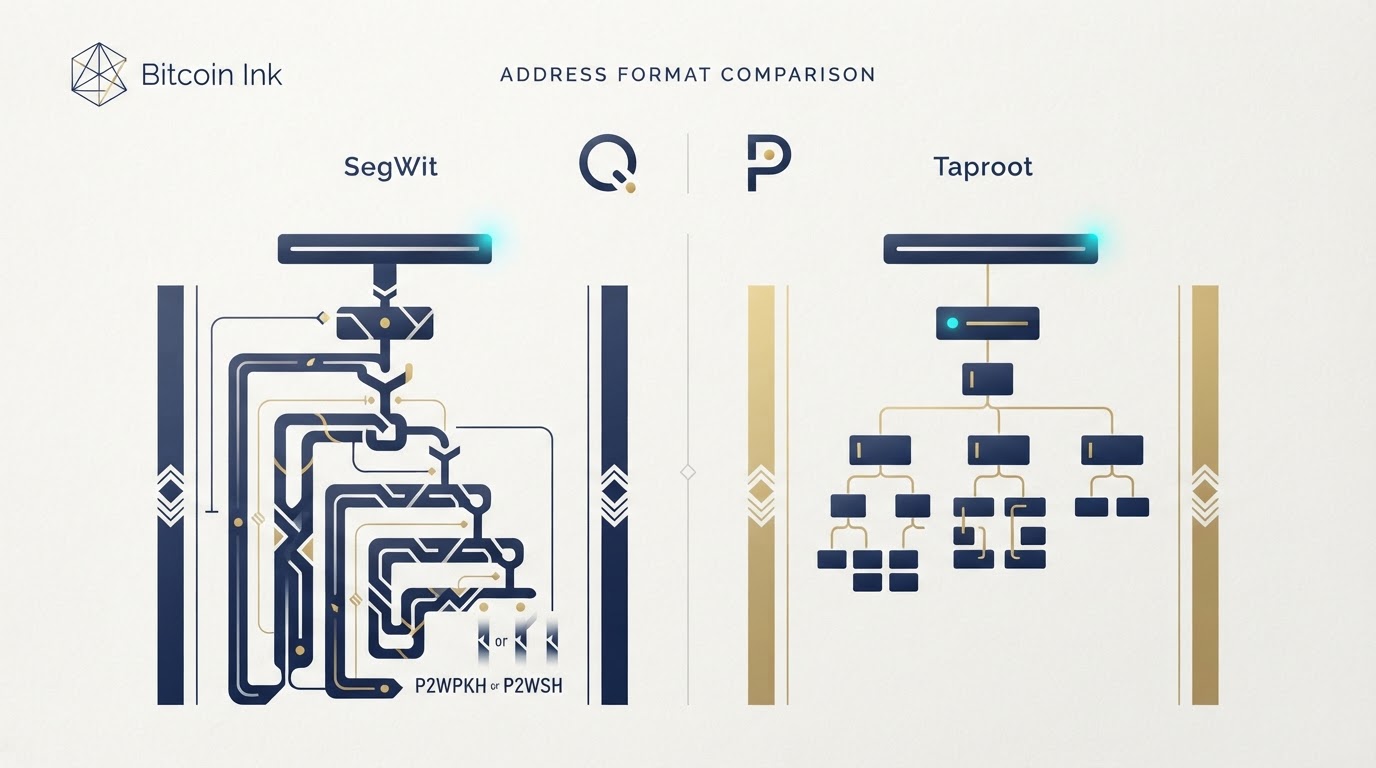
SegWit and Taproot are two Bitcoin transaction designs with different address formats.
Quick Answer
SegWit (Segregated Witness) and Taproot are both Bitcoin upgrade technologies that changed how transactions are structured. Native SegWit uses witness version 0 addresses (starting with bc1q) and separates signature data from transaction data, reducing effective transaction size. Taproot uses witness version 1 addresses (starting with bc1p) and introduces Schnorr signatures, which can make complex spending conditions look like simple ones on-chain. Both use Bech32-family encoding. Fees depend on the full transaction structure, not just which prefix you use.
💡 Key Takeaways
SegWit and Taproot are two Bitcoin transaction designs with different address formats and spending capabilities.
Native SegWit addresses start with bc1q; Taproot addresses start with bc1p, and both use Bech32-family encoding.
Transaction fees depend on the structure of the transaction, not just the address prefix.
Existing received outputs do not change format—your old addresses keep working.
Different script types enable different spending conditions; compatibility depends on the wallet and recipient.
Key Takeaways
Two different designs: SegWit and Taproot are distinct upgrades with different address formats and spending features.
Different prefixes: Native SegWit addresses start with bc1q; Taproot addresses start with bc1p.
Fees depend on structure: the address prefix alone does not determine your fee—transaction size and script type do.
Old addresses keep working: existing received outputs do not change format when new types arrive.
Compatibility varies: not every wallet or service supports every address type—check before sending.
Table of Contents
What Is SegWit?
SegWit (Segregated Witness) is a Bitcoin upgrade that separated signature ("witness") data from the transaction body. By moving signatures to a separate part of the transaction, SegWit reduced the effective size of transactions and fixed a bug called transaction malleability. Native SegWit addresses (witness version 0) start with bc1q and use Bech32 encoding (BIP141).
The practical effect is that SegWit transactions can be smaller in virtual bytes than legacy transactions, which can mean lower fees for the same payment. But the savings depend on the transaction structure—how many inputs, what script types they use—not just on using a SegWit address.
What Is Taproot?
Taproot is a later Bitcoin upgrade that introduced Schnorr signatures and a new witness version (version 1). Taproot addresses start with bc1p and use Bech32m encoding (BIP341). One key feature of Taproot is that complex spending conditions—like multisig—can be made to look like a simple single-signature spend on-chain. This can improve privacy and, in some cases, reduce the data size of complex transactions.
Taproot does not automatically make every transaction cheaper. For simple single-signature transactions, the fee difference between SegWit and Taproot may be small. The benefits are more significant for complex spending conditions and privacy. See our article on Bech32 addresses for more on the encoding itself.
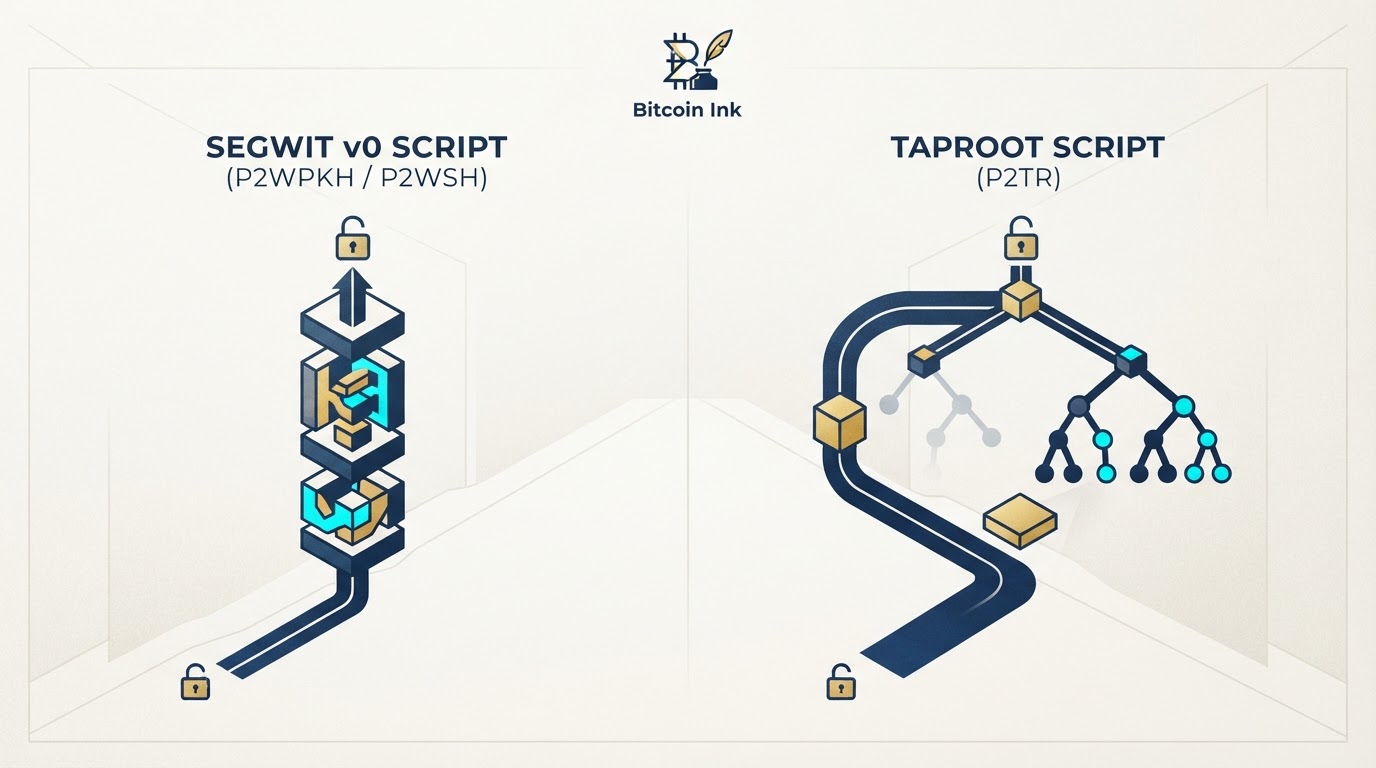
Different script types enable different spending conditions; fees depend on the full structure.
Address Formats and Prefixes
Bitcoin has several address types, each with a distinct prefix and script type:
Type
Prefix
Witness Version
Encoding
Legacy (P2PKH)
1...
—
Base58
Nested SegWit
3...
0 (wrapped)
Base58
Native SegWit
bc1q...
0
Bech32
Taproot
bc1p...
1
Bech32m
The prefix tells you the script type at a glance, but it does not tell you the fee. A transaction spending a Taproot output may cost more or less than one spending a SegWit output, depending on the inputs and outputs involved.
How Fees Relate to Script Type
Bitcoin fees are based on transaction size in virtual bytes. Different script types contribute different amounts of data per input and output. SegWit introduced a discount for witness data, which reduced the virtual size of transactions that use SegWit inputs. Taproot's Schnorr signatures can be smaller for certain spending paths, but the effect on a simple transaction may be modest.
The key point: fees depend on the full transaction structure, not just the address prefix. A transaction with many inputs costs more than one with few, regardless of script type. A transaction spending Taproot outputs is not automatically cheaper than one spending SegWit outputs. For a fuller explanation of how fees work, see our guide on why Bitcoin transaction fees are so high.
Compatibility and Existing Outputs
An important point: existing received outputs do not change format. If you received Bitcoin to a SegWit address, that output remains a SegWit output. Taproot does not retroactively change your existing UTXOs. You can continue to spend old outputs using their original script type.
When choosing a new address type for receiving, compatibility matters. Not every wallet, exchange, or service supports every address type. Some older services may not support sending to bc1p Taproot addresses. Before receiving to a new address type, confirm that the sender's service supports it. For wallet options that support modern address types, see our Bitcoin wallets guide.
Choose the Right Bitcoin Wallet
Wallet support for address types varies. Find a wallet that supports the formats you need.
Not necessarily. For simple single-signature transactions, the fee difference may be small. Taproot's benefits are more significant for complex spending conditions and privacy. Fees depend on the full transaction structure, not just the address type.
Do my old addresses change when Taproot arrives?
No. Existing received outputs keep their original script type. A SegWit output remains a SegWit output. Taproot does not retroactively change your existing UTXOs.
Can every wallet send to bc1p addresses?
Not always. Some older services do not support sending to Taproot addresses. Before receiving to a bc1p address, confirm the sender's service supports it.
What is the difference between Bech32 and Bech32m?
Bech32 is the encoding used for witness version 0 (Native SegWit, bc1q) addresses. Bech32m is a related encoding with a different checksum, used for witness version 1+ (Taproot, bc1p) addresses. Both are Bech32-family encodings.
What does SegWit actually do?
SegWit separates signature (witness) data from the transaction body, reducing the effective size of transactions and fixing transaction malleability. This can reduce fees for transactions that use SegWit inputs.
Key takeaway: SegWit and Taproot are two Bitcoin transaction designs with different address formats (bc1q vs bc1p) and spending capabilities. Fees depend on the full transaction structure, not just the prefix, and existing outputs do not change format. Check wallet and service compatibility before using a new address type.
Not necessarily. For simple single-signature transactions, the fee difference may be small. Taproot's benefits are more significant for complex spending conditions and privacy. Fees depend on the full transaction structure, not just the address type.
Do my old addresses change when Taproot arrives?
No. Existing received outputs keep their original script type. A SegWit output remains a SegWit output. Taproot does not retroactively change your existing UTXOs.
Can every wallet send to bc1p addresses?
Not always. Some older services do not support sending to Taproot addresses. Before receiving to a bc1p address, confirm the sender's service supports it.
What is the difference between Bech32 and Bech32m?
Bech32 is the encoding used for witness version 0 (Native SegWit, bc1q) addresses. Bech32m is a related encoding with a different checksum, used for witness version 1+ (Taproot, bc1p) addresses. Both are Bech32-family encodings.
What does SegWit actually do?
SegWit separates signature (witness) data from the transaction body, reducing the effective size of transactions and fixing transaction malleability. This can reduce fees for transactions that use SegWit inputs.
Enjoyed this story?
Share it with your network and help others discover the history and utility of Bitcoin.
Disclaimer: This content is provided for general educational and informational purposes and is not financial, investment, legal, or tax advice. Bitcoin involves risk, including the possible loss of value. Consider your circumstances and consult qualified professionals when appropriate.