Bitcoin Ink Editorial Team•November 27, 2026•8 min read
Share:
On chain vs Lightning compares Bitcoin base-layer transactions with payments made through the Lightning Network. Both move Bitcoin, but they work differently, cost differently, and settle differently. Understanding the tradeoffs helps you choose the right method for each payment.
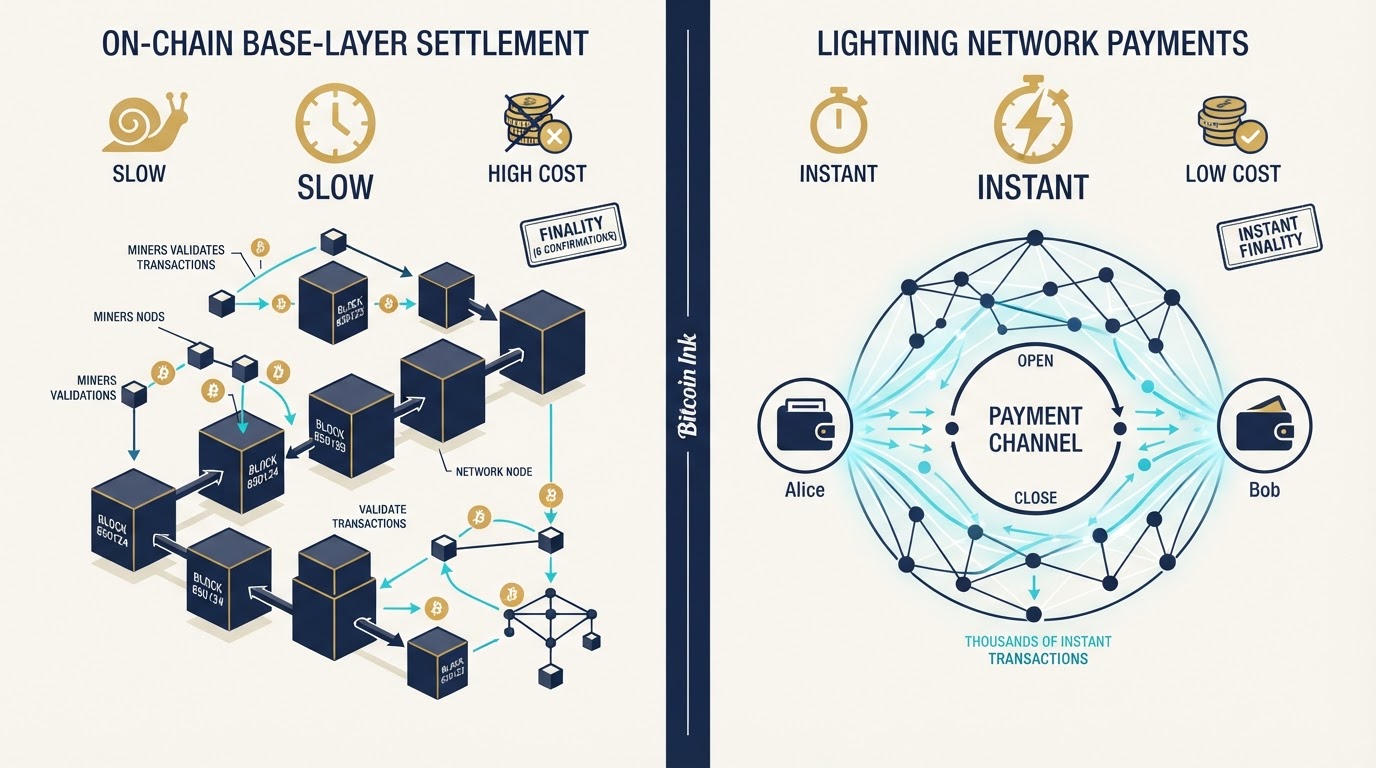
On-chain and Lightning are two ways to move Bitcoin with different tradeoffs.
Quick Answer
On-chain transactions are Bitcoin's base-layer payments—recorded on the blockchain and settled by miners. Lightning Network payments are off-chain, routed through payment channels between participants. On-chain fees depend on transaction size and network demand; Lightning fees depend on routing and channel liquidity. On-chain settlement is final after confirmation; Lightning payments are near-instant but require channel management and have liquidity constraints. Neither is universally better—each suits different payment sizes and situations.
💡 Key Takeaways
On-chain transactions settle on Bitcoin's base layer; Lightning payments route through off-chain payment channels.
On-chain fees depend on transaction data size and network demand; Lightning fees depend on routing and channel liquidity.
On-chain settlement is final after confirmation; Lightning payments are instant but require channel management.
Lightning has liquidity and routing constraints that on-chain payments do not.
Neither is universally better—each suits different payment sizes and use cases.
Key Takeaways
Two layers: on-chain is the base layer; Lightning is a layer-2 payment network.
Different fee models: on-chain fees scale with data size; Lightning fees scale with routing complexity.
Settlement: on-chain is final after block confirmation; Lightning is instant but requires channel management.
Liquidity: Lightning has routing and channel capacity constraints that on-chain does not.
Not universally better: each suits different payment sizes and use cases.
Table of Contents
How Each Works
On-chain transactions are Bitcoin's fundamental payment mechanism. You create a transaction, sign it, broadcast it to the network, and miners include it in a block. Once confirmed, the payment is settled on the blockchain. Fees depend on the transaction's data size and the current fee rate (sat/vB). See our guide on why Bitcoin transaction fees are so high for details.
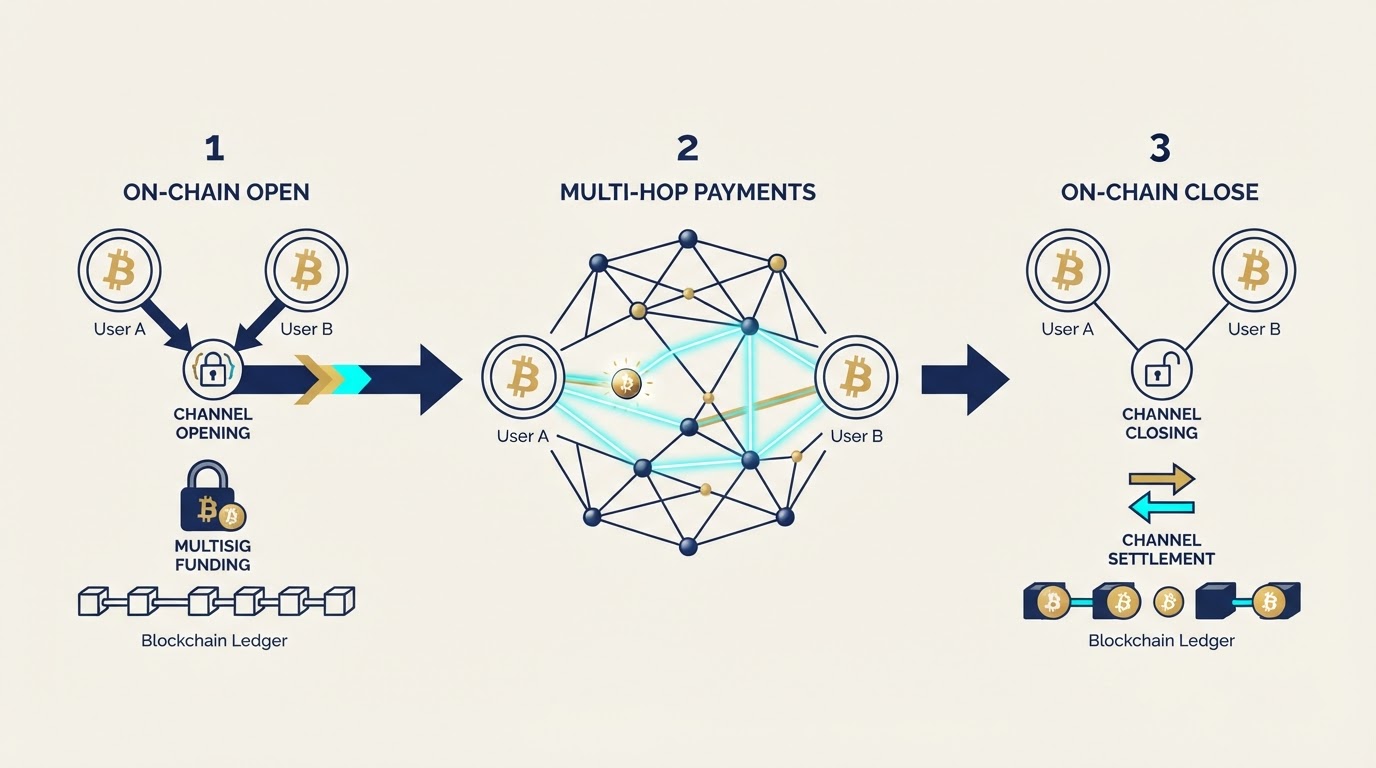
Lightning Network payments work differently. Participants open payment channels by creating an on-chain transaction that funds a multi-signature address. Once the channel is open, they can send payments back and forth off-chain, updating the channel balance. These off-chain payments are near-instant and can cost fractions of a cent. To close a channel, another on-chain transaction settles the final balance on the blockchain. Payments can also route through a network of channels to reach recipients you do not have a direct channel with. See the Lightning BOLTs specification for technical details.
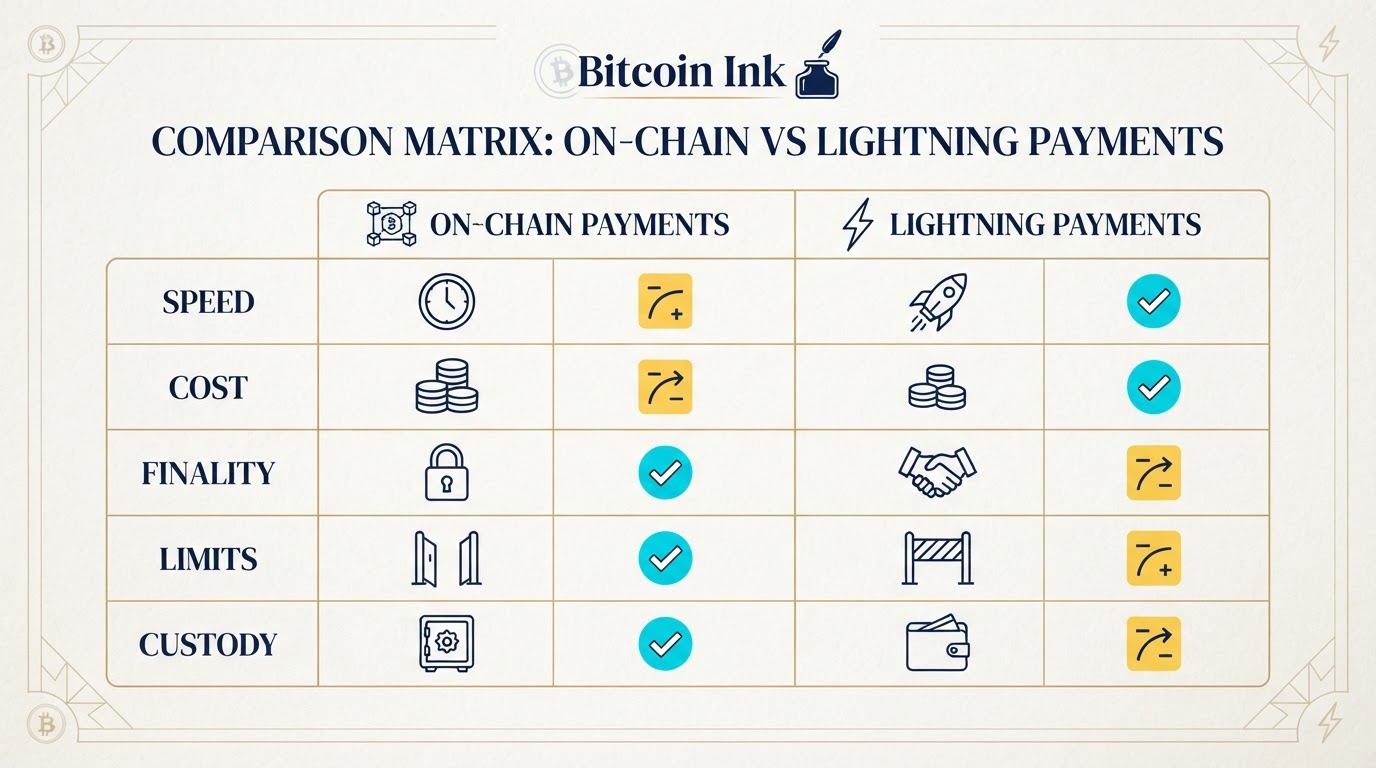
On-chain and Lightning have different tradeoffs across speed, cost, finality, and custody.
Comparison Table
Feature
On-Chain
Lightning
Speed
Minutes to hours (block confirmation)
Near-instant
Fees
Based on transaction data size
Based on routing; typically lower
Settlement
Final after block confirmation
Instant but requires channel management
Limits
No practical limit
Limited by channel capacity
Custody
Direct on-chain keys
Channel keys; some setups involve third parties
Fees
On-chain fees depend on the transaction's data size in virtual bytes and the fee rate you choose. When the network is busy, fees rise because transactions compete for limited block space. Lightning fees depend on routing—how many hops your payment takes and the fee each hop charges. Lightning fees are typically much lower than on-chain fees, especially for small payments, but they are not zero and can vary.
Settlement and Finality
On-chain settlement is final once a transaction is confirmed in a block. The more confirmations, the more secure the settlement. Lightning payments are settled off-chain through channel balance updates—near-instant but not recorded on the blockchain until the channel is closed. This means Lightning payments are fast but require the channel to remain open and both parties to cooperate (or use the on-chain fallback if they do not).
A Lightning channel opens on-chain, processes payments off-chain, and closes on-chain.
Liquidity and Routing
Lightning has a constraint that on-chain does not: channel capacity. Each channel has a fixed amount of Bitcoin that can flow in each direction. If a channel lacks the liquidity to route your payment, the payment may fail and need to find another route. On-chain payments have no such constraint—any amount can be sent if you have the Bitcoin and can pay the fee. This makes Lightning better for frequent, smaller payments and on-chain better for large or one-time transfers.
Custody
On-chain, you control your keys directly. Lightning requires managing channel keys and monitoring channels for attempted fraud. Some Lightning wallet setups involve third-party custodians who manage channels on your behalf—meaning you may not hold all your own keys. Self-custodial Lightning wallets exist but require more technical knowledge. Understand your wallet's custody model before using Lightning. See our Bitcoin wallets guide for options.
Understand Lightning Invoices
Lightning payments use invoices to request payment. Learn how they work before sending.
Not always. Lightning fees are typically lower for small payments, but routing fees and channel management costs can add up. For large payments, on-chain may be more practical because Lightning has channel capacity limits.
Are Lightning payments instant?
They are near-instant—typically settling in fractions of a second. But they are not "universally instant"; routing failures, channel capacity issues, or node downtime can cause delays or failures.
Do I need to open a channel to use Lightning?
Not necessarily. Some Lightning wallets manage channels for you automatically. Others let you open and manage your own channels. The level of control and custody depends on the wallet you choose.
Can Lightning payments fail?
Yes. If a route cannot be found with sufficient capacity, or if a node along the route is offline, the payment can fail. On-chain payments do not have this routing constraint.
Is Lightning more private than on-chain?
Lightning payments are not recorded on the public blockchain, which can improve privacy. But routing information may be visible to intermediate nodes. Neither is universally more private—each has different privacy tradeoffs.
Key takeaway: On-chain and Lightning are two ways to move Bitcoin with different tradeoffs. On-chain is final but slower and costlier; Lightning is fast and cheap but has liquidity and routing constraints. Neither is universally better—choose based on your payment size and use case.
Not always. Lightning fees are typically lower for small payments, but routing fees and channel management costs can add up. For large payments, on-chain may be more practical because Lightning has channel capacity limits.
Are Lightning payments instant?
They are near-instant—typically settling in fractions of a second. But they are not 'universally instant'; routing failures, channel capacity issues, or node downtime can cause delays or failures.
Do I need to open a channel to use Lightning?
Not necessarily. Some Lightning wallets manage channels for you automatically. Others let you open and manage your own channels. The level of control and custody depends on the wallet you choose.
Can Lightning payments fail?
Yes. If a route cannot be found with sufficient capacity, or if a node along the route is offline, the payment can fail. On-chain payments do not have this routing constraint.
Is Lightning more private than on-chain?
Lightning payments are not recorded on the public blockchain, which can improve privacy. But routing information may be visible to intermediate nodes. Neither is universally more private—each has different privacy tradeoffs.
Enjoyed this story?
Share it with your network and help others discover the history and utility of Bitcoin.
Disclaimer: This content is provided for general educational and informational purposes and is not financial, investment, legal, or tax advice. Bitcoin involves risk, including the possible loss of value. Consider your circumstances and consult qualified professionals when appropriate.